
What Are Edge AI Test Agents?
Edge AI Test Agents are autonomous, machine-learning-powered diagnostic tools built directly into embedded devices. Unlike traditional diagnostic systems that rely on off-device processing, these agents perform real-time analysis on the device itself, using neural networks and intelligent models to detect anomalies, predict failures, and even suggest corrective actions.
Think of them as smart watchdogs living inside your system: constantly learning normal behavior, spotting patterns that signal issues, and acting faster than any human engineer could.
Why Edge AI Test Agents Are a Big Deal
The rise of the Internet of Things (IoT), autonomous vehicles, and real-time automation demands embedded systems that are robust, adaptable, and self-aware. Here’s where Edge AI Test Agents shine:
The journey from wafer probe to packaged final test isn’t just a physical flow; it’s a data journey. Once a wafer moves from fabrication into wafer sort, assembly, packaging, and final test, every measurement, anomaly, and metadata entry becomes critical input for product reliability and business decisions.
That’s why building a unified data pipeline between wafer-level processes and ATE (Automated Test Equipment) testing isn’t just beneficial; it’s becoming a necessity.
Why a Unified Pipeline Matters
As testing evolves and device complexity explodes, fragmented data can slow root-cause analysis, confuse yield learning, and increase test escapes. A consistent data pipeline from wafer fabrication to final packaged test enables three major advantages:
- Better traceability from wafer coordinates to packaged unit IDs
- Continuous yield learning without manual report stitching
- Faster insight sharing between design, validation, and manufacturing
When both engineering and production teams see the same structured dataset, there are fewer blind spots and far fewer late surprises.
More Than Just a Test Flow: It’s an Intelligence System
Test workflows aren’t just execution checkpoints. They are feedback systems enabling:
- Smarter binning strategies
- Data-driven screening
- Earlier detection of drift and failure trends
Where supported and practical, ATE platforms can capture parametric measurements, test signatures, per-pin data, limited waveform data, and real-time conditions, all with consistent tagging across the product lifecycle.
It transforms testing into a structured intelligence layer instead of a disconnected manufacturing step.
Bridging the Gap Between Design and Production
Developing embedded systems that perform reliably in the real world is a huge engineering challenge. That’s where deep diagnostics and robust testing methodologies come in. For decades, solutions in test engineering have been the backbone of bringing resilient products to market. Today, embedding AI into diagnostics takes this to the next level.
Traditionally, system validation relied on scheduled manual tests or post-production checks. With Edge AI Test Agents embedded into the device firmware or operating system, systems constantly monitor their own health and performance. These agents use data to flag early signs of degradation, for instance, a memory error pattern that could predict future failure, helping engineers intervene before a small glitch turns into a costly breakdown.
Elevating ATE Testing with Intelligent Agents
Automated Test Equipment (ATE) has long been the industry’s go-to for functional and performance verification of hardware and integrated circuits during manufacturing. However, once products leave the factory floor, ATE’s role diminishes, until now.
By integrating AI test capabilities directly into devices, engineers can simulate aspects of ATE testing throughout a product’s life cycle. Edge AI Test Agents can:
- Monitor signals and performance metrics once only observable in controlled test environments.
- Capture complex fault signatures that help refine future ATE test patterns.
- Provide remote diagnostics that maintain quality without physical access to test setups.
In essence, smart test agents extend the value of ATE testing into the operational phase, creating a new layer of lifecycle quality assurance.
Building the Architecture: From Prober to Data Lake
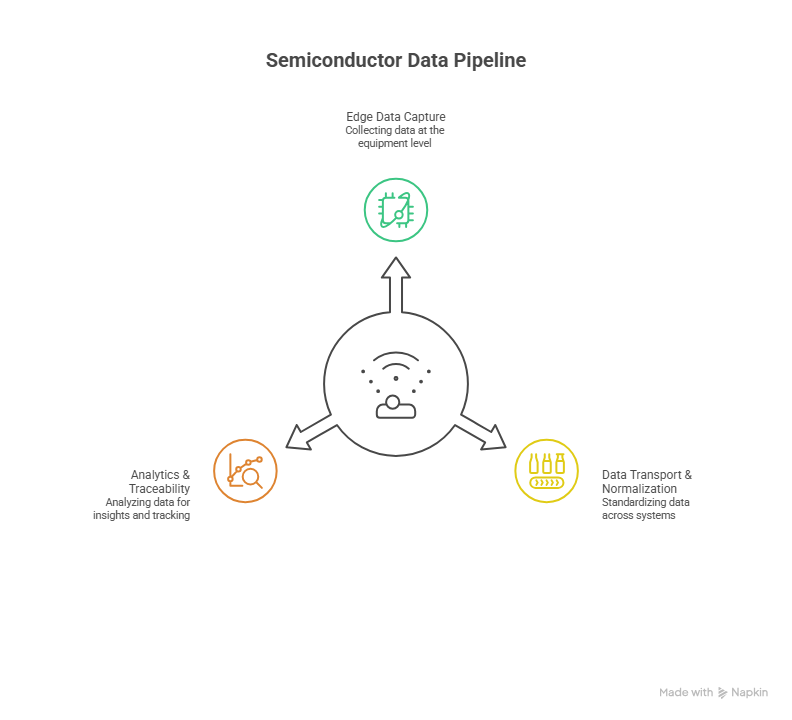
A robust pipeline linking wafer testing and final device packaged test typically includes three structured layers:
1. Edge Data Capture
Data collection begins at the equipment level, including probers, handlers, and ATE. Metadata must include:
- Test program revision
- Device coordinates
- Bin/sublot identity
- Environmental parameters
Embedding consistency at this stage avoids expensive downstream cleanup.
2. Data Transport & Normalization
Once collected, data moves through a message-handling layer. Here, identifiers, formatting, test naming conventions, and timestamps become standardized, mitigating inconsistencies across multiple systems and tester vendors.
3. Analytics, Traceability & Action
Finally, data lands in a combination of cold storage (raw logs) and structured analytics environments powering:
- Statistical and machine-learning yield models
- SPC dashboards
- Correlation views (wafer to packaged device)
- Automated failure flagging and screening support
The benefit? Faster iteration and intelligent manufacturing feedback loops.
Ensuring Quality at Scale: Best Practices in High-Volume Test Engineering
Structured Metadata: The Secret Ingredient
Even the most advanced system fails if test programs don’t emit structured metadata. Engineering teams should consistently tag:
- Test program versions
- Board and socket IDs
- Site configuration
- Temperature, frequency, and operating regions
This single step shortcuts countless debug loops by answering the dreaded question:
“Did this fail because something changed, or because something broke?”
Cross-Stage Intelligence: Closing the Loop
A unified view of semiconductor testing enables powerful automation:
- Real-time alerts when yield deviates
- Predictive modelling to supplement known-good-die screening and risk classification
- Rules-based decision support for retest, scrap review, or debug prioritization
- Machine learning to catch subtle drift patterns
Simply put, data stops being historical and becomes actionable.
Multi-Vendor Reality: Making Integration Practical
Most fabs and OSAT environments do not operate on a single vendor ecosystem. Probers, ATE, handlers, and analytics platforms typically originate from different suppliers.
That’s why the best pipelines rely on:
- Vendor-neutral schemas
- Standardized formats and equipment interfaces
- APIs where available
- Modular ingestion pipelines
This makes scaling, from engineering validation to HVM, a smoother evolution rather than a reinvention.
Human Adoption Still Matters
Even the most advanced architecture fails if teams don’t use it. Successful deployment hinges on:
- Training engineering and operations teams
- Version controlling all test assets
- Starting small and expanding the data scope over time
When the process is usable, consistent, and integrated into daily decision-making, adoption becomes natural, not forced.
Where the ATE Fits Best
Modern ATE platforms have the capability to:
- Support tester-side data collection, adaptive test flows, and analytics integration
- Export structured measurement data
- Scale from characterization to volume
- Support diverse device domains (digital, RF, analog, power)
In short, the tester becomes a core data source, not just a pass/fail checkpoint.
The right wafer testing configuration ensures traceability begins at the first touchpoint and carries through to packaged screening.
Tessolve: Your Partner in Unified Wafer-to-Final Test Systems
At Tessolve, we specialize in bridging the gap between wafer sort and high-volume final test. With global test labs, advanced ATE platforms like the 93K, and deep expertise in characterization, automation, and scaling, our teams ensure your data pipeline works across engineering and production, not just in theory, but in real manufacturing environments.
Our seasoned test engineering team builds scalable test programs, develops load boards and probe card hardware, enables yield correlation studies, and integrates data capture across both wafer testing and final packaged device test.
Because we operate across the entire silicon validation lifecycle, from design support to post-silicon debug, we deliver a unified testing ecosystem rather than isolated testing stages.
Whether you’re optimizing production flows, introducing new products, or scaling toward automation and AI-driven quality systems, Tessolve helps you accelerate deployment confidently, efficiently, and with measurable operational impact.
Frequently Asked Questions
1. What are Edge AI Test Agents in embedded systems?
Improved failure detection, faster yield analysis, better traceability, and more informed corrective actions.
2. How can ATE platforms support end-to-end testing?
They support scalable test execution and structured data generation, but end-to-end traceability requires integration with wafer maps, device IDs, MES, handlers/probers, and analytics infrastructure.
3. What challenges occur without a unified data pipeline?
Teams face inconsistent reporting, slower debug cycles, recurring failure patterns, manual data stitching, and difficulty identifying root cause issues efficiently.
4. Can this unified pipeline work with multiple equipment vendors?
Yes, with well-defined schemas, middleware, and governance, integration across different equipment vendors can be achieved, though it typically requires careful mapping and validation.
5. Who typically benefits most from implementing this approach?
Test engineers, yield teams, product engineers, and manufacturing operations gain efficiency, clearer insights, and faster decision-making from unified test intelligence.