Modern semiconductor innovation continues to push the boundaries of performance, driven by AI, HPC, automotive electronics, and edge computing. However, as transistor density increases, one critical challenge remains: heat.
While transistor counts have continued to grow, power density has not scaled at the same pace, leading to the rise of Dark Silicon, where portions of a chip must remain inactive to stay within thermal and power limits. As a result, modern chip architects are focusing on smarter thermal and power management rather than simply increasing performance.
With the adoption of 2nm and sub-2nm process nodes, chiplet-based architectures, 3D-IC integration, HBM-enabled computing, and AI accelerators, thermal throttle modeling has become a fundamental part of designing high-performance, energy-efficient processors.
Understanding Dark Silicon
Dark Silicon refers to the portion of an integrated circuit that must remain inactive, or “dark,” during operation because activating all transistors simultaneously would generate excessive heat and exceed available power budgets.
Interestingly, this isn’t a manufacturing defect; it is a consequence of physics.
Modern processors may contain billions of transistors, but thermal constraints prevent all of them from operating at maximum frequency simultaneously. Designers must constantly decide which blocks remain active and which temporarily enter low-power states.
Common examples include:
- AI accelerators
- GPU compute units
- DSP engines
- Multimedia processors
- Neural Processing Units
- Vector execution units
- High-performance CPU cores
Rather than running every functional block continuously, the system dynamically activates only the hardware required for the current workload.
Why Thermal Throttling Matters
Thermal throttling is an automatic mechanism that reduces processor performance when temperatures exceed safe operating limits.
Without throttling, excessive temperatures can cause:
- Timing violations
- Reliability degradation
- Electromigration
- Reduced transistor lifespan
- Higher leakage currents
- System instability
Although throttling protects hardware, excessive thermal events significantly reduce overall application performance.
The challenge for architects is therefore straightforward:
Minimize thermal throttling without compromising performance or energy efficiency.
What is Thermal Throttle Modeling?
Thermal throttle modeling predicts how a processor behaves when workloads generate heat over time.
Instead of reacting after overheating occurs, architects simulate thermal behavior during the design phase.
Modern thermal models estimate:
- Junction temperatures
- Heat propagation
- Power density
- Workload distribution
- Thermal hotspots
- Cooling efficiency
- Dynamic voltage-frequency behavior
These simulations help engineers determine whether an architecture will remain within thermal limits before manufacturing begins.
Moving Beyond Traditional Power Analysis
Earlier processor generations primarily optimized for:
- Static power
- Dynamic power
- Area
- Timing closure
Today’s architectures require significantly more comprehensive analysis.
Modern thermal models incorporate:
- Dynamic Voltage and Frequency Scaling (DVFS)
- Adaptive Voltage Scaling
- Power gating
- Clock gating
- Machine Learning-based workload prediction
- AI-assisted thermal forecasting
- Predictive hotspot analysis
- Digital Twin-based thermal simulations
Agentic AI-powered EDA workflows now assist architects in exploring thousands of thermal-performance tradeoffs simultaneously, dramatically reducing design iterations while improving Power, Performance, and Area (PPA).
Architectural Strategies for Managing Dark Silicon
1. Intelligent Power Gating
Power gating remains one of the most effective architectural techniques for reducing leakage power and controlling heat generation in modern processors. Instead of keeping every functional block powered continuously, unused sections of the chip are completely disconnected from the power supply whenever they are not needed.
This significantly lowers static power consumption while reducing unnecessary thermal buildup across the die.
Common blocks that are dynamically power-gated include:
- Idle GPU clusters
- Cache partitions
- Neural Processing Units (NPUs)
- DSP cores
- Multimedia accelerators
- Peripheral interfaces
Modern processors can transition these blocks between active, standby, and sleep states within microseconds. Thermal throttle models help determine when power gating should be activated so that performance remains unaffected while maintaining safe operating temperatures.
2. Dynamic Voltage and Frequency Scaling (DVFS)
Different workloads require different levels of computational performance. Running every core at maximum voltage and frequency all the time wastes energy and quickly increases chip temperature.
Dynamic Voltage and Frequency Scaling (DVFS) continuously adjusts operating voltage and clock frequency based on workload intensity, thermal conditions, and power availability. During lighter workloads, processors reduce voltage and frequency to save energy, while demanding applications temporarily increase performance when thermal headroom is available.
Connecting Billions: The Role of Embedded Systems in Global IoT Growth
Key benefits include:
- Lower heat generation
- Reduced dynamic power consumption
- Improved battery life in portable devices
- Better energy efficiency
- Longer sustained performance before thermal throttling occurs
Modern thermal throttle models evaluate thousands of workload scenarios to determine the optimal voltage-frequency combinations that maximize performance while remaining within thermal limits.
3. Heterogeneous Computing
Modern System-on-Chips (SoCs) are no longer built around identical processor cores. Instead, they integrate specialized processing units designed for different types of workloads.
Typical heterogeneous architectures include:
- High-performance CPU cores
- Energy-efficient CPU cores
- AI accelerators
- Graphics Processing Units (GPUs)
- Digital Signal Processors (DSPs)
- Dedicated video encoding and decoding engines
Rather than executing every task on high-performance cores, intelligent schedulers assign workloads to the most suitable hardware accelerator. AI inference, multimedia processing, image enhancement, and signal processing can often be completed on specialized engines with significantly lower power consumption, reducing thermal hotspots and improving overall efficiency.
4. Workload Migration
Heat rarely develops uniformly across a processor. Certain cores or accelerators may become significantly hotter than others depending on application behavior.
Workload migration helps distribute computational activity across different processing units by dynamically moving threads or tasks away from overheated regions. This prevents localized thermal hotspots while allowing cooler parts of the chip to share the processing load.
Modern operating systems and runtime schedulers continuously monitor processor temperatures and intelligently relocate workloads before critical thermal limits are reached. This proactive approach helps delay thermal throttling, improves sustained performance, and enhances long-term silicon reliability.
5. Thermal-Aware Task Scheduling
Traditional scheduling algorithms primarily focused on maximizing processor utilization. Modern processors, however, incorporate thermal awareness into scheduling decisions to maintain both performance and reliability.
In addition to workload priority, thermal-aware schedulers evaluate factors such as:
- Core temperature
- Package temperature
- Historical thermal behavior
- Available cooling capacity
- Power budget
- Current workload intensity
By intelligently balancing computational tasks across multiple processing elements, these schedulers prevent overheating while maintaining higher sustained clock frequencies over longer periods.
6. Chiplet-Aware Thermal Optimization
As chiplet-based architectures become increasingly common, thermal management extends beyond individual processor cores. Each chiplet generates heat independently, while neighboring chiplets influence one another through the package and interconnect.
Architects now incorporate chiplet-aware thermal optimization during floorplanning and package design by:
- Strategically placing high-power chiplets
- Optimizing inter-chiplet communication paths
- Balancing power density across the package
- Improving heat dissipation through advanced packaging technologies
- Coordinating thermal policies across multiple chiplets
These strategies are particularly important for AI processors, high-performance computing systems, and advanced heterogeneous platforms, where multiple compute, memory, and I/O chiplets operate simultaneously within a shared thermal envelope.
AI is Changing Thermal Management
Artificial Intelligence has become an integral part of thermal optimization.
Instead of relying solely on predefined thermal thresholds, AI models continuously learn workload behavior.
They predict:
- Future hotspot formation
- Power spikes
- Frequency requirements
- Cooling effectiveness
- Thermal saturation
Machine Learning models now perform predictive thermal and signal integrity analysis, allowing designers to identify critical thermal issues long before silicon fabrication begins.
This proactive approach significantly improves first-pass silicon success.
Chiplets Introduce New Thermal Challenges
Chiplet architectures improve scalability but complicate thermal behavior.
Unlike monolithic dies, chiplets communicate through advanced packaging technologies such as:
- UCIe
- 2.5D packaging
- 3D stacking
- Hybrid Bonding
Each chiplet generates heat independently while simultaneously influencing neighboring chiplets.
Thermal models must therefore simulate:
- Inter-chiplet heat transfer
- Package-level thermal resistance
- TSV heating
- Interposer behavior
- Memory stack temperatures
These considerations are becoming essential for AI processors and HPC platforms.
3D ICs Make Heat Even More Complex
Stacking dies vertically significantly increases computational density. However, it also makes heat removal much more challenging. Upper dies retain heat generated by lower layers.
Thermal throttle models now evaluate:
- Vertical heat conduction
- Through-Silicon Via (TSV) temperatures
- Layer-wise power density
- Cooling efficiency
- Thermal coupling
Without careful architectural planning, 3D ICs may experience severe performance degradation despite offering higher transistor density.
Thermal Modeling During Physical Design
Thermal optimization is no longer limited to architecture teams.
Physical design engineers increasingly incorporate thermal analysis into:
- Floorplanning
- Macro placement
- Clock tree synthesis
- Power grid design
- Routing
- Signoff verification
Hot modules are intentionally separated to minimize thermal coupling.
AI-driven physical design tools further optimize placement by simultaneously considering congestion, timing, IR drop, and thermal behavior.
Dark Silicon and AI Accelerators
AI hardware represents one of the fastest-growing sources of thermal complexity. Large matrix multiplication engines generate enormous power densities.
Thermal-aware AI accelerator design includes:
- Dynamic tensor allocation
- Accelerator partitioning
- Adaptive frequency scaling
- Smart memory scheduling
- Runtime workload balancing
Inference workloads differ significantly from training workloads, making adaptive thermal policies increasingly important.
High-Bandwidth Memory Adds Another Dimension
HBM dramatically increases memory bandwidth but also introduces thermal interactions. Memory stacks often sit adjacent to, or directly above, compute dies.
Architects must model:
- Memory temperatures
- Controller hotspots
- Package cooling
- Bandwidth utilization
- Thermal interference
Balancing compute throughput with memory temperature has become a major optimization challenge in HPC systems.
The Role of Digital Twins
One of the biggest advancements in semiconductor engineering is the use of digital twins. A digital twin creates a virtual representation of the chip, with this, architects can simulate:
- Temperature evolution
- Workload execution
- Cooling mechanisms
- Aging effects
- Reliability degradation
Instead of waiting for prototype silicon, engineers validate thermal behavior early, reducing costly redesigns.
Reliability Starts with Thermal Awareness
Thermal issues affect far more than immediate performance.
Long-term exposure to high temperatures accelerates:
- Electromigration
- Negative Bias Temperature Instability (NBTI)
- Hot Carrier Injection
- Dielectric breakdown
- Metal fatigue
Thermal throttle modeling therefore contributes directly to:
- Product lifetime
- Manufacturing yield
- Reliability
- Warranty reduction
- Customer satisfaction
Why Thermal Modeling is Becoming a Competitive Advantage
As semiconductor complexity continues to increase, thermal optimization has evolved into a strategic differentiator.
Leading chip design companies increasingly integrate thermal intelligence into every stage of development, from architecture exploration to physical implementation and post-silicon validation. Likewise, every advanced VLSI design company now treats thermal modeling as an essential element of achieving predictable performance, reliability, and power efficiency.
Modern VLSI chip design is no longer about maximizing transistor density alone. It is about delivering sustained performance within realistic thermal limits while ensuring long-term product reliability. Organizations that successfully combine AI-assisted EDA, predictive thermal analysis, chiplet-aware architecture, and intelligent runtime management will continue defining the next generation of semiconductor innovation.
Why Partner with Tessolve for Advanced Semiconductor Engineering?
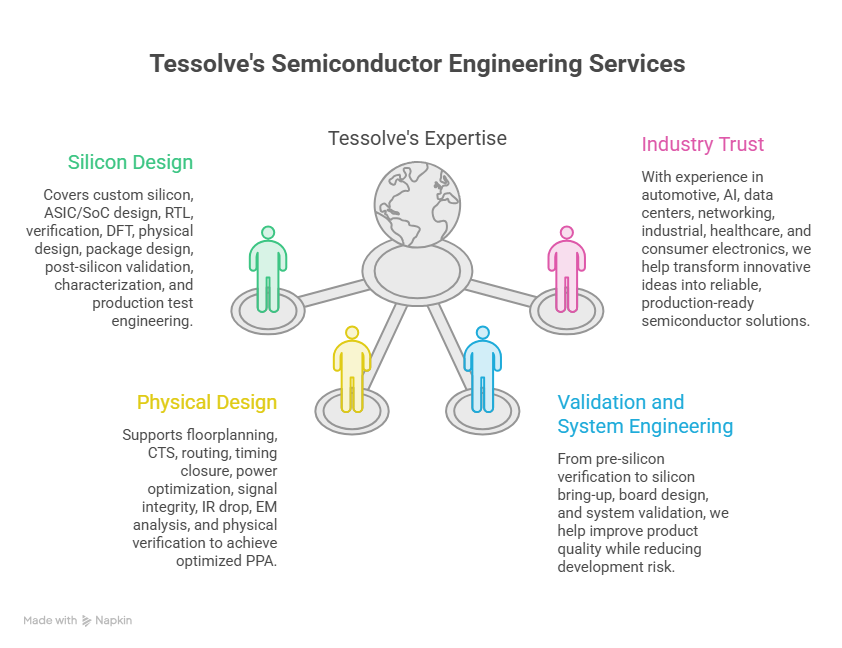
At Tessolve, we deliver end-to-end semiconductor engineering services that help customers overcome complex design, power, and thermal challenges while accelerating the journey from concept to production.
- Complete Silicon Design Expertise: Our capabilities cover custom silicon, ASIC/SoC design, RTL, verification, DFT, physical design, package design, post-silicon validation, characterization, and production test engineering.
- Advanced Physical Design Solutions: We support floorplanning, CTS, routing, timing closure, power optimization, signal integrity, IR drop, EM analysis, and physical verification to achieve optimized Power, Performance, and Area (PPA).
- End-to-End Validation and System Engineering: From pre-silicon verification to silicon bring-up, board design, and system validation, we help improve product quality while reducing development risk.
- Trusted Across Multiple Industries: With experience in automotive, AI, data centers, networking, industrial, healthcare, and consumer electronics, we help transform innovative ideas into reliable, production-ready semiconductor solutions.
Frequently Asked Questions
1. What is Dark Silicon?
Dark Silicon refers to inactive portions of a chip that must remain powered down to stay within thermal and power limits.
2. Why is thermal throttle modeling important?
It predicts overheating scenarios early, enabling architects to optimize performance, reliability, and power efficiency before fabrication.
3. How does AI improve thermal management?
AI predicts workload behavior, forecasts hotspots, optimizes voltage-frequency settings, and enables proactive thermal control during both design and runtime.
4. Why are chiplets more difficult to cool?
Multiple chiplets generate localized heat, creating complex thermal interactions across interposers, packages, and stacked dies that require advanced modeling.
5. How does thermal-aware architecture improve chip reliability?
By minimizing prolonged thermal stress, it reduces degradation mechanisms like electromigration and NBTI, extending silicon lifespan and maintaining consistent performance.