
As semiconductor devices continue to scale down in size and ramp up in performance, one challenge stands out above many others: thermal behavior. Heat isn’t just a byproduct of activity in modern chips; it’s one of the pivotal factors that determine reliability, performance, and long-term device behavior. With power densities rising and process nodes shrinking to 5 nm and beyond, thermal effects increasingly influence signal timing, current leakage, and overall device integrity throughout the manufacturing lifecycle. This makes thermal-aware testing not only a best practice but a necessity for future-ready semiconductor validation.
In this blog, we’ll explore why thermal-aware strategies are crucial, how engineering teams can incorporate thermal awareness into their test flows, and practical considerations for adopting comprehensive thermal test-based validation.
Why Thermal Awareness Matters in Modern Semiconductor Testing
Imagine you’re stress-testing an advanced System-on-Chip (SoC) designed for automotive ADAS or next-gen mobile platforms. Your test routines push logic blocks to their limits, but the device is heating up faster than expected. Without properly accounting for temperature variations, what looks like a functional fault might simply be a thermal-induced performance issue, one that could disappear in cooler lab conditions but bite you in real-world applications.
Thermal concerns impact semiconductor devices in multiple ways:
- Performance variation: Transistor switching speeds and threshold voltages are highly temperature dependent.
- Leakage currents: Higher temperatures often increase leakage, affecting low-power designs.
- Reliability degradation: Long-term exposure to heat accelerates wear-out mechanisms like electromigration.
- Timing shifts: Interconnect and logic timing can shift with temperature, possibly leading to false failures.
Traditional test patterns often overlook these dynamic thermal effects, risking mischaracterized functionality. As a result, test flows that ignore heat can reduce yield visibility or fail to catch field failures that only manifest at certain temperatures.
Core Elements of Thermal-Aware Testing
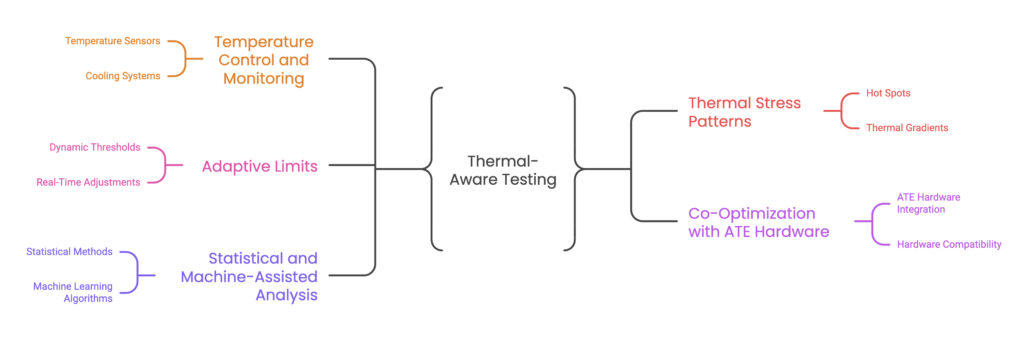
To adapt to these challenges, organizations must evolve beyond static test cases and build a holistic thermal-aware testing regime. Let’s break down some key components:
1. Temperature Control and Monitoring
Integrate temperature sensors or thermal monitors on silicon and in the test environment to accurately measure the device’s temperature during test sequences. Thermal sensors provide real-time feedback and help distinguish between genuine defects and thermally induced performance shifts.
2. Thermal Stress Patterns
Rather than merely verifying logical correctness, embed test patterns that deliberately generate thermal stress across hot spots of the chip. These patterns help trigger latent defects that might only surface under heat, such as weak interconnects or marginal transistor behavior.
3. Adaptive Limits Based on Thermal Conditions
Instead of fixed pass/fail thresholds, use adaptive limits that factor in thermal states. This means setting temperature-informed boundaries for signal timing, voltages, and power metrics. These dynamic thresholds help test engineers better understand device behavior across a realistic temperature range.
4. Co-Optimization with ATE Hardware
Modern ATE testing systems must support thermal profiling and rapid adjustments to test parameters based on the measured temperature. ATE platforms that allow thermal cycling, environmental chambers, and responsive pattern execution give test engineers the flexibility they need for insightful characterization.
5. Statistical and Machine-Assisted Analysis
Leverage statistical models or AI for anomaly detection across thermal datasets. By correlating thermal signatures with functional results, teams can spot subtle trends that static analytics often miss. Data-driven insights not only improve the detection of field risks but also optimize test time by focusing on critical temperature ranges.
Building Thermal Awareness Across Test Engineering Stages
Achieving thermal-aware testing is not something you tack on at the last minute; it must permeate your entire test engineering workflow, from silicon bring-up to production test:
Early Silicon Characterization
As soon as the first silicon arrives, focus on thermal characterizations. Measure on-chip temperature sensors, correlate with external equipment data, and build early models of thermal behavior. This informs how much compensation the main production tests will require.
Pre-Production ATE Development
Modify your ATE test programs to handle dynamic temperature profiles. This could involve calibrating thermal chambers, setting up stepped temperature sweeps, and creating patterns that reflect realistic operating conditions rather than only lab benchmarks.
Correlation Between Engineering and Production Tests
Ensure that thermal behaviors observed in lab environments correlate with mass-production runs. If your production test flow uses reduced thermal variation, you might miss issues that only appear under stress conditions. Strong correlation between environments helps catch these edge cases earlier.
The Business Value of Thermal-Aware Testing
Incorporating thermal insights into your semiconductor test strategy isn’t just a technical upgrade; it’s a business advantage. A well-designed thermal test strategy can:
- Boost yield fidelity: Reduce false positives and negatives by accounting for thermal influences on device metrics.
- Shorten time-to-market: Uncover heat-related anomalies early to minimize redesign iterations.
- Enhance field reliability: Deliver devices that perform predictably, even in thermally challenging environments like automotive or edge data centers.
- Optimize test costs: Data-driven thermal testing avoids unnecessary redundancy and focuses efforts where issues truly matter.
Thermal Management Strategies for High-Performance PCBs
Tessolve: Your Partner for Thermal-Aware Testing Excellence
At Tessolve, we recognize that modern semiconductor validation needs more than just standard routines; it needs temperature-aware, data-informed, and scalable approaches that ensure reliability from prototype to mass production. With over 20 years of experience in semiconductor testing, we combine deep domain expertise with advanced lab infrastructure and global reach to help customers tackle their toughest challenges.
Our end-to-end testing services include robust ATE program development, test hardware design, system-level test capabilities, characterization services and JEDEC/AECQ reliability services that factor in thermal behavior, performance limits, and real-world conditions. With access to over 40 ATE platforms, device/package qualification & reliability labs and collaboration labs spanning multiple geographies, we’re equipped to support partners across small innovators and large OEMs alike.
Choosing Tessolve means partnering with a team that not only understands the complexities of thermal-aware testing but has the infrastructure and intellectual capital to execute sophisticated validation flows that accelerate product success in today’s competitive semiconductor landscape.
Frequently Asked Questions (FAQs)
1. What is thermal-aware testing in semiconductor devices?
It evaluates device performance under varying temperature conditions to ensure reliability, accuracy, and real-world operating stability.
2. Why is thermal behavior critical for next-generation semiconductor chips?
Advanced nodes generate higher power density, making temperature variations significantly impact performance, leakage, and long-term reliability.
3. How does thermal-aware testing improve product quality?
It helps identify heat-induced failures early, reducing field issues and improving yield confidence before mass production.
4. Which industries benefit most from thermal-aware testing strategies?
Automotive, aerospace, data centers, and high-performance computing benefit due to strict reliability and operating-temperature requirements.
5. When should thermal considerations be introduced into the test flow?
Thermal considerations should begin during early silicon characterization and continue through production testing for consistent results.