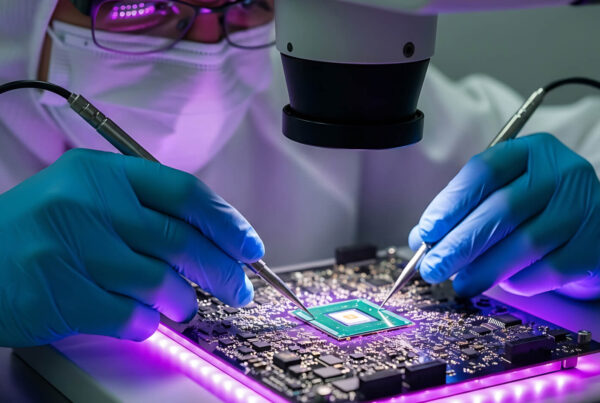
Heat dissipation is a major challenge for high-performance PCBs (Printed Circuit Boards). As systems become smaller and more powerful, components generate more heat in tighter spaces. This puts both performance and reliability at risk. Modern PCBs now support high-speed processing, dense component placement, and high-power devices, making thermal management a critical design requirement rather than an afterthought.
This is where comprehensive PCB design services are helpful. These services may ensure your high-performance PCB operates at peak efficiency, extending its lifespan and functionality by implementing effective heat management techniques.
Understanding the Heat Problem
A PCB’s heat accumulation can come from several sources:
- Integrated circuits (ICs): The workhorses of a PCB are integrated circuits (ICs), which process data and carry out calculations. A result of their activities is heat.
- Power Delivery Components:: Voltage regulators and power converters generate heat while managing power flow.
- Passive components: Resistors, capacitors, and inductors can produce heat, mainly when they are operating at high currents.
Excess heat can have detrimental effects on a PCB:
- Performance degradation: The component’s efficiency decreases as temperature rises, leading to performance throttling and potential failures.
- Reduction in component lifespan: High temperatures accelerate the deterioration of electronic components, potentially leading to early failure.
- Increased risk of failure: Overheating can damage solder joints or delaminate PCB layers, resulting in irreversible board failure.

Effective Thermal Management Strategies
PCB board design services use a multifaceted approach to thermal management to address these issues:
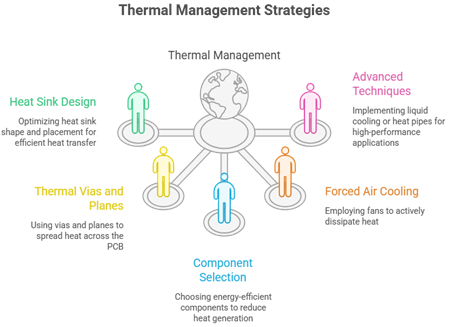
- Design and Location of Heat Sinks: Heat sinks are passive cooling devices that release heat into the surrounding air after absorbing it from components. To maximize heat transfer efficiency, the PCB layout service carefully puts heat sinks on the PCB near hot components. The heat sink’s actual design is essential, taking into account factors like fin arrangement, surface area, and material (copper or aluminum). Optimizing airflow direction and heat sink orientation further improves cooling efficiency.
- Thermal Vias and Planes: Thermal vias, or conductive routes that move heat from interior layers to the surface where a heat sink may disperse it, are incorporated into PCB hardware design. Furthermore, thermal planes are sizable copper regions on the PCB that serve as heat spreaders and smooth out heat distribution. Dense via stitching and optimized copper balancing are widely used in modern multilayer PCBs for efficient heat spreading.
- Component Selection: Choosing parts with reduced power consumption or greater thermal resistance will help reduce heat generation during the PCB design service process. This could entail selecting components rated for higher operating temperatures or utilizing energy-efficient processors.Power-efficient architectures directly reduce thermal load at the source.
- Forced Air Cooling: PCB hardware services may suggest adding fans for active cooling in cases where passive cooling is insufficient. By forcing air across the PCB, these fans hasten heat dissipation. However, fan placement and selection are essential to provide sufficient airflow without causing noise or vibration problems.
- Advanced Techniques: PCB designing services may investigate advanced techniques such as liquid cooling systems, heat pipes, or even specific substrate materials with higher thermal conductivity for high-performance applications.These techniques are increasingly used in high-power computing, telecom infrastructure, and dense electronic systems.
Collaboration is Key
Close cooperation between several stakeholders is necessary for effective thermal management:
- Providers of PCB design service: These experts design PCBs with efficient heat dissipation using optimized layouts, thermal vias, and heat sinks.
- Component manufacturers: Selecting components with reduced thermal resistance or integrated heat spreaders can significantly reduce thermal challenges.
- Providers of thermal management solutions: Manufacturers of fans, heat sinks, and cooling systems provide valuable guidance on integration and selection.
Early-stage collaboration helps prevent thermal issues instead of fixing them later.
Benefits of Effective Thermal Management
PCB board design services may provide high-performance PCBs with several benefits by implementing these strategies.
- Improved Performance: Dependable and sustained performance results from efficient thermal management, which keeps components operating within their ideal temperature range.
- Extended Lifespan: Electronic components with lower heat accumulation have a longer lifespan, reducing the risk of early failure and extending the product life cycle.
- Increased Reliability: An appropriately managed heat source lowers the possibility of heat-related failures, making the printed circuit board (PCB) more trustworthy.
- Cost Savings: Efficient heat management can result in considerable long-term cost savings by reducing early component failure and boosting product reliability.
The Role of Simulation and Testing
Thermal management calls for thorough simulation and testing in addition to design decisions. PCB design service use thermal simulation software to simulate heat movement throughout the PCB layout. This enables them to locate possible hotspots before building tangible prototypes. Early identification and resolution of thermal issues in the design process can save time and money by incorporating simulation results into design iterations.
Thermal testing is essential when a physical prototype is available. Using specialized equipment such as thermal cameras, the temperature distribution throughout the surface of the PCB can be measured. This in-the-real-world testing confirms the efficacy of the thermal management plan and permits additional tweaks if needed.
The Future of Thermal Management
Strategies for managing heat will change along with technology. Among the new trends are:
- Advanced materials: For even more effective heat dissipation, PCBs may incorporate new materials with higher thermal conductivity, such as gallium nitride or diamond.
- Microfluidic cooling: As microscopic channels are included in the PCB, very high-performance applications may be able to use extremely effective liquid cooling methods.
- Artificial intelligence (AI): Design tools with AI capabilities can evaluate thermal data, recommend better layouts, or recommend components for better thermal control.
- System-Level Thermal Co-Design: Modern designs are moving toward chip-package-PCB co-design, where thermal management is considered across the entire hardware stack rather than only at the board level.
- Digital Twin and Predictive Analysis: Advanced simulation environments are enabling digital twin models that replicate real-world thermal behavior, allowing engineers to predict failures and optimize designs before manufacturing.
By keeping up with these developments, providers of PCB design services and PCB hardware design can guarantee their customers access to the newest and best thermal management solutions for their high-performance PCBs.
Conclusion
Thermal management is an essential component of creating high-performance PCBs. By leveraging PCB design, layout, and hardware design specialists, you can build PCBs that operate at optimal temperatures, ensuring maximum efficiency, longevity, and reliable performance. Recall that a well-thought-out thermal management plan maximizes the usefulness and cost of your high-performance PCB, making it an investment that pays off over time.
Tessolve: Empowering the Future of High-Speed PCB Design
At Tessolve, we understand what it takes to engineer reliable, high-speed systems in today’s rapidly evolving electronics landscape. With deep expertise in high-speed SerDes design, advanced stackup engineering, controlled impedance routing, SI/PI simulation, validation, and end-to-end hardware execution, we help global customers build performance-driven boards with confidence. Our Tessolve teams combine engineering excellence with strong lab infrastructure, compliance knowledge, and manufacturing alignment to deliver designs that perform, scale, and succeed in real-world deployment. Whether you’re pushing data rates higher, simplifying complexity, or accelerating development cycles, Tessolve stands as your trusted partner for robust, future-ready PCB innovation.
Frequently Asked Questions
1. How do PCB design tools manage power and thermal constraints?
PCB design tools simulate power distribution and heat flow to identify hotspots early. They help optimize component placement, routing, and copper usage to balance power integrity and thermal performance.
2. How do thermal vias help manage high temperatures in power electronics?
Thermal vias transfer heat from high-power components to inner layers or heat spreaders. This reduces localized hotspots and improves overall heat dissipation in power-dense PCB designs.
3. How should thermal management components be sourced for PCB design?
Thermal components should be sourced based on thermal requirements, material quality, compatibility, and reliability. Engineers often collaborate with suppliers to select suitable heat sinks, fans, and cooling solutions.
4. What types of heat sinks are used in PCB thermal management?
Common heat sinks include passive aluminum or copper sinks, finned heat sinks, and extruded designs. Advanced systems may use heat pipes or liquid-cooled heat sinks for higher thermal loads.