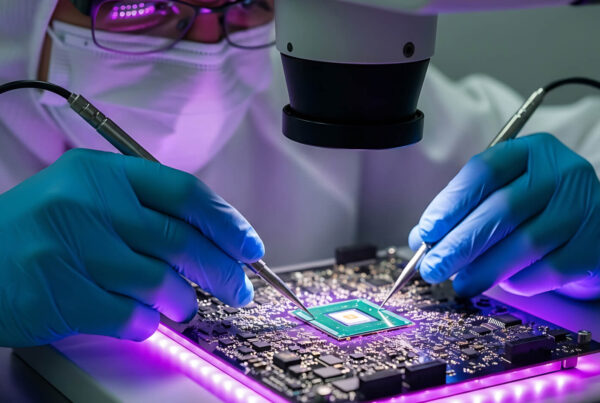
Printed Circuit Board (PCB) design is both a science and an art, requiring a deep understanding of electrical engineering principles, materials science, and manufacturing processes. It becomes significantly more complex when designing an Automated Test Equipment (ATE) PCB, which is widely used for high-speed functional, parametric, and reliability testing of semiconductor ICs, such as:
- Microprocessors
- Memory chips (DDR, HBM)
- System-on-Chip (SoC)
- Graphics Processing Units (GPUs)
- Analog and Mixed-Signal ICs
- Power Management ICs
The art of ATE PCB design involves balancing several competing factors to create functional, efficient hardware for testing the Device Under Test (DUT). In this blog, we will go through some factors to consider when designing an ATE PCB.
Signal Integrity
Signal Integrity refers to the ability of electrical signals to maintain their quality and accuracy as they travel through the PCB. As ATE PCBs are meant to test Semiconductor chips, PCB quality is paramount, as it affects the accuracy and reliability of test results. Factors such as impedance discontinuities, signal reflections, crosstalk, insertion loss, and jitter can degrade signal integrity in modern high-speed ATE PCBs. Best practices such as balanced stack-ups, controlled impedance routing, back-drilled vias, advanced SI simulation, and proper termination help maintain signal integrity.
Power Integrity
Power Integrity refers to the stability and reliability of a PCB’s power delivery system. To test today’s low-voltage and power-sensitive semiconductors, ATE PCBs need to be designed with a good Power Distribution Network (PDN). It plays a crucial role in ensuring stable voltage levels, reducing power noise and losses, and improving overall power efficiency. Solid power planes, optimized PCB stack-ups, low-ESR decoupling capacitors, and PDN simulation help ensure stable power delivery for advanced semiconductor devices.
Mechanical Constraints
ATE PCBs connect to various equipment such as test heads, handlers, and probers for high-volume automated IC testing. Each type of equipment has specific mechanical requirements that must be considered during the ATE PCB design process. When the device under test (DUT) is an RF device, it is essential to position the cables and their connectors on the PCB as close to the DUT as possible to facilitate connections with RF test instruments. Modern ATE PCBs must also accommodate advanced IC packages, including flip-chip BGAs, wafer-level packages, and chiplet-based devices.
Multi-Layered PCB
The complexity and electrical requirements of the ATE PCBs call for a multi-layered structure. The high routing density and the need for dedicated layers for Power, Ground, and Signals can increase the layer count to over 80 layers for complex semiconductor test applications. Multi-layer PCBs tend to warp during reflow soldering. The PCB is made of different materials: resin, glass fibers, and copper. Each material has its own thermal properties, and when the PCB undergoes a thermal cycle, the materials expand at a different rate, causing the PCB to warp. Advanced stack-up optimization and material selection help minimize PCB warpage while improving high-speed electrical performance.
Advanced Via Technology
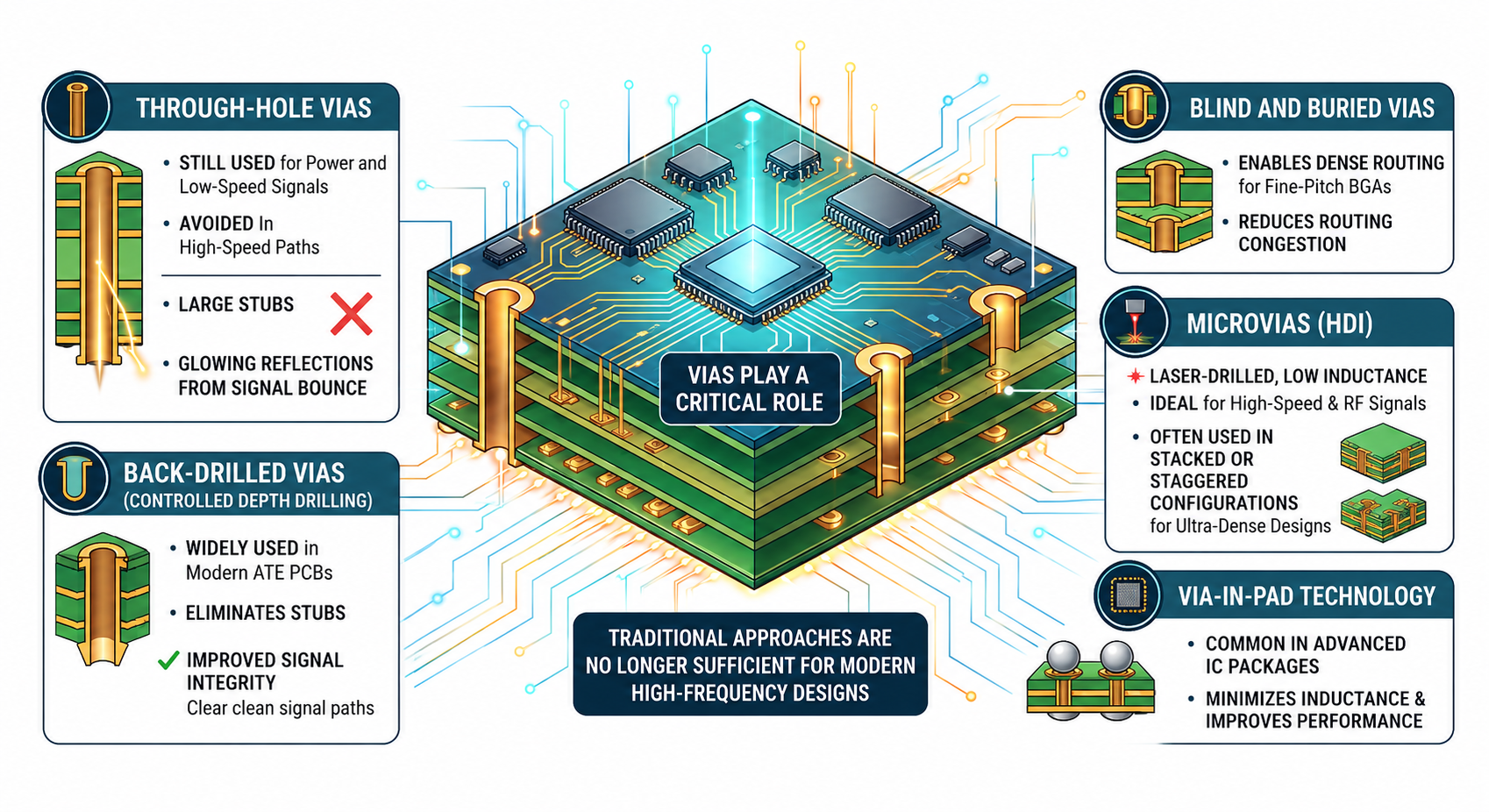
Vias play a critical role in high-speed ATE PCB performance. Traditional via approaches are no longer sufficient for modern high-frequency designs.
Updated via strategies include:
- Through-hole vias: Still used for power and low-speed signals, but avoided in high-speed paths due to large stubs
- Back-drilled vias (Controlled Depth Drilling): Widely used in modern ATE PCBs to eliminate stubs and improve signal integrity
- Blind and Buried vias: Enable dense routing for fine-pitch BGAs and reduce routing congestion
- Microvias (HDI): Laser-drilled, low inductance, ideal for high-speed and RF signals. Often used in stacked or staggered configurations for ultra-dense designs
- Via-in-pad technology: Common in advanced IC packages for minimizing inductance and improving performance
- Sequential lamination: Enables ultra-high-density routing for advanced HDI and chiplet-based test boards.
Choosing the right via strategy directly impacts signal performance, manufacturability, and cost.
Thermal Management (New Critical Consideration)
Modern ATE PCBs must handle high power densities due to advanced IC testing, especially for AI accelerators, HBM-enabled devices, chiplet-based processors, and high-performance SoCs.
Key strategies include:
- Thermal vias and heat spreading planes
- Use of high thermal conductivity materials
- Active cooling interfaces in test setups
- AI-assisted thermal simulation and airflow analysis
Proper thermal management ensures consistent test conditions and prevents measurement drift.
EMI/EMC Optimization
High-speed ATE PCBs are highly susceptible to electromagnetic interference (EMI), which can affect test accuracy and signal quality. Proper grounding, shielding, controlled return paths, and optimized PCB stack-ups help minimize EMI/EMC issues, ensuring reliable measurements and compliance with industry standards.
Conclusion
Designing ATE PCBs today goes far beyond traditional PCB practices. Modern test boards must support AI processors, chiplet-based devices, HBM memory, advanced packaging, and ultra-high-speed interfaces while maintaining excellent signal, power, and thermal integrity. Tessolve brings extensive expertise in high-complexity ATE PCB design, SI/PI analysis, advanced PCB technologies, and manufacturing-ready solutions for global semiconductor companies. Backed by award-winning engineering and end-to-end semiconductor design capabilities, Tessolve helps customers accelerate reliable testing for next-generation devices.
FAQs
1. What is an ATE PCB, and why is it important?
An ATE PCB is used to test semiconductor ICs, ensuring accurate performance validation, reliability, and quality during production.
2. What is an ATE load board, and why is it important in semiconductor testing?
An ATE load board connects the automated test equipment to the device under test, ensuring accurate signal transmission and reliable semiconductor validation.
3. How does signal integrity impact ATE PCB performance?
Poor signal integrity causes distortion, reflections, and noise, leading to inaccurate test results and unreliable semiconductor validation.
4. What is an ATE reference design, and how does it simplify ATE board design?
An ATE reference design provides proven design guidelines that help engineers accelerate ATE board design, improve reliability, and reduce development risks for semiconductor testing.
5. What should be considered when designing a high-performance ATE test board?
A high-performance ATE test board requires optimized signal and power integrity, thermal management, advanced via technology, and reliable manufacturability for accurate IC testing.