

Semiconductors have always powered progress, but today the expectations from chips are drastically higher than they were even a decade ago. Devices must be faster, smarter, more efficient, and incredibly reliable, all while reaching the market at record speed. This growing complexity has fundamentally changed how validation and quality assurance are approached. What was once considered a final manufacturing checkpoint has now evolved into a strategic, lifecycle-wide discipline. That transformation marks the beginning of a new era: moving confidently from silicon to fully functional systems.
In this evolving landscape, test engineering sits right at the center of innovation. Instead of being seen as a delay factor or a cost overhead, testing has become an enabler of business success. Whether we’re talking about AI accelerators, next-generation automotive platforms, or ultra-low-power IoT devices, the ability to validate performance, resilience, and reliability at every stage is what truly differentiates great products from the rest.
Why Testing Has Become So Strategic
Modern chips are no longer simple computational units. They integrate CPUs, GPUs, connectivity modules, memory interfaces, security engines, and more, all on a single die. Naturally, this level of integration demands equally sophisticated validation strategies. This is where SoC testing plays a critical role. With everything packed into one compact architecture, ensuring synchronized operation under real-world workloads becomes essential.
At the same time, the industry has shifted from “Does it work?” to “Does it work everywhere, every time, in every condition?” That’s where semiconductor testing has transformed dramatically. Engineers now evaluate behavior across voltages, temperatures, aging conditions, environmental stress, and performance thresholds. The result? Safer products, better user experiences, and far fewer post-launch surprises.
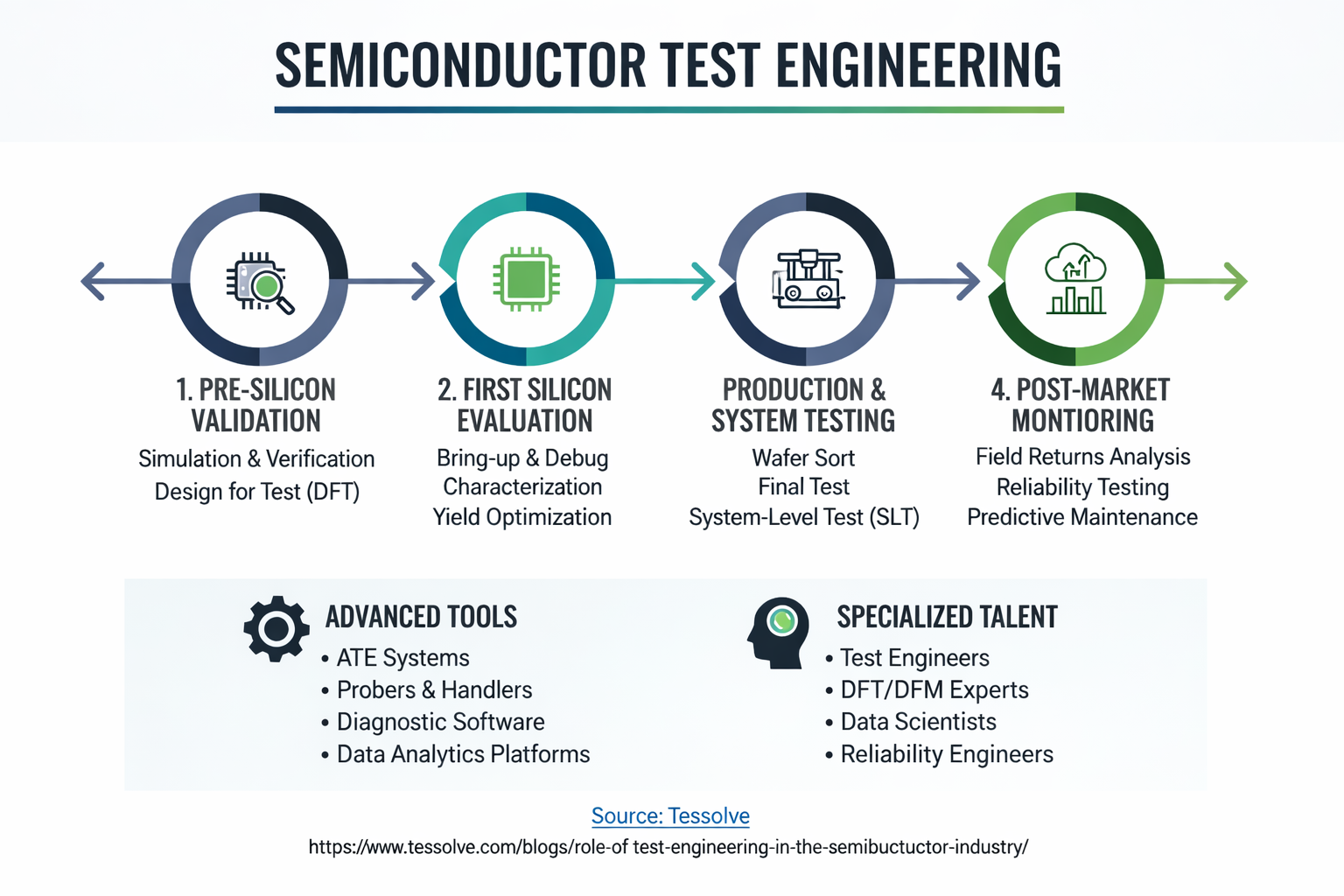
From Pre-Silicon to Post-Deployment: Testing Across the Lifecycle
One of the biggest changes in modern methodology is how early testing begins. It starts before any physical chip even exists.
1. Pre-Silicon Validation
Virtual models, simulations, and emulation platforms help engineering teams predict how designs will behave in the real world. Architectural flaws can be identified here, long before fabrication. This significantly reduces redesign cost and accelerates timelines.
2. First Silicon Evaluation
When the first samples arrive, they undergo intensive analysis termed as device characterization . Functional behavior, power performance, compliance, and timing stability are examined carefully and compared to the Design specification and validated as per Test Architecture Any deviations from expectations trigger collaborative debugging between hardware, firmware, and design teams. This phase bridges theory and physical reality.
3. Production & System Testing
Once validated, chips move into high-volume manufacturing environments. Automated workflows ensure yield consistency, and every unit is checked rigorously. Parallel to this, system-level validation ( SLT) ensures seamless operation when chips are integrated into final products, whether it’s a smartphone, industrial controller, or advanced automotive module. While SLT for complex digital systems focuses on software interaction and high-speed data protocols, SLT for analog power devices (e.g., PMICs, smart power switches, inverters) focuses on validation under real-world, high-current, thermal, and electrical stress conditions.
4. Post-Market Monitoring
Even after deployment, data keeps teaching valuable lessons. Field analytics, failure trends, and performance metrics all loop back into improving future designs and strengthening testing strategies. This continuous-learning cycle is now a powerful competitive advantage.
Tools, Technology, and Intelligent Automation
Modern validation relies on advanced platforms like Advantest and Teradyne ATE systems, precision probing, custom load boards, and comprehensive characterization setups. These tools allow engineers to push devices to their operational limits under carefully controlled conditions. Environmental chambers test temperature extremes while automated infrastructure accelerates throughput without compromising quality.
Equally important is the software side. Today’s frameworks bring together program development environments, debug utilities, analytics dashboards, and real-time reporting systems. Together, they unlock deeper insights, improve decision-making, and dramatically reduce time to market. When executed well, test engineering is as much about intelligence as it is about instrumentation.
Talent at the Heart of Innovation
Advanced tools are essential, but exceptional talent makes the real difference. Modern test engineering requires engineers who can seamlessly combine knowledge of silicon physics, system behavior, automation frameworks, firmware integration, and data analytics. Collaboration across disciplines is just as critical as technical skill. Teams that balance creativity, precision, and cross-functional expertise are driving the development of reliable, production-ready technology and setting new standards for system-level quality.
Automating Post-Silicon Validation: Trends in High-Speed Debug and Traceability
Tessolve: Enabling Confidence from Design to Deployment
At Tessolve, we proudly stand at the forefront of this new testing era. With deep expertise across the semiconductor lifecycle, we deliver truly end-to-end validation solutions designed to help customers accelerate innovation with confidence. Our capabilities span comprehensive planning, advanced program development, lab characterization, production enablement, reliability qualification, and seamless system validation. Whether customers need robust SoC testing support or highly specialized semiconductor testing services, our teams offer proven experience across leading ATE platforms, Bench Validation solution , Device reliability & qualifications as per industry standards , next-generation technologies, and complex product categories.
Backed by world-class labs, global engineering talent, and decades of domain knowledge, we help companies reduce risk, enhance yield, optimize performance, and reach the market faster, without compromise. At Tessolve, we don’t just validate technology; we help shape dependable, future-ready products that inspire trust in every application.
Frequently Asked Questions
1. Why is end-to-end testing so important now?
Modern chips are highly complex, requiring validation from design to deployment to ensure reliability, consistency, and real-world performance.
2. How is lifecycle testing different from traditional testing?
Traditional testing happens after fabrication, while lifecycle testing begins pre-silicon and continues through production, system validation, and field feedback.
3. How does SoC complexity impact testing?
Greater integration demands deeper validation for performance, interfaces, power behavior, security, and extreme real-world operating conditions.
4. Why do companies invest heavily in semiconductor testing?
Strong testing reduces field failures, improves quality, boosts yields, accelerates market launch, and strengthens customer trust.
5. Which industries rely most on advanced testing?
Automotive, Medical, Aerospace, consumer electronics, telecommunications,industrial systems, and AI applications depend heavily on robust, Chip and system-level testing.