The Internet of Things (IoT) has transformed the way we interact with the world around us. From smart home appliances to wearable fitness trackers, these devices are becoming a part of our day-to-day lives. According to the McKinsey Global Institute, IoT applications will generate between $4 trillion to $11 trillion economy by 2025. However, the foundational element of these advanced devices is semiconductors. Current projections suggest this momentum will push the global semiconductor market toward an aspirational $1 trillion valuation by 2030, largely fueled by the explosion of connected endpoints.
Semiconductors are the building blocks of modern electronics. They are tiny chips made up of silicon that control the flow of electricity and handle complicated computation operations. Due to their versatility, they are used in a wide range of functions, and the development and operations of IoT devices are one of them. Top semiconductor company NXP is working towards developing innovative chip solutions for IOT devices for consumer, automotive, and industrial applications. Modern IoT ecosystems now rely on Heterogeneous Integration, where diverse components like sensors, radios, and processors are combined into a single System-on-Chip (SoC) or System-in-Package (SiP).
The Role of Semiconductors In IoT Devices
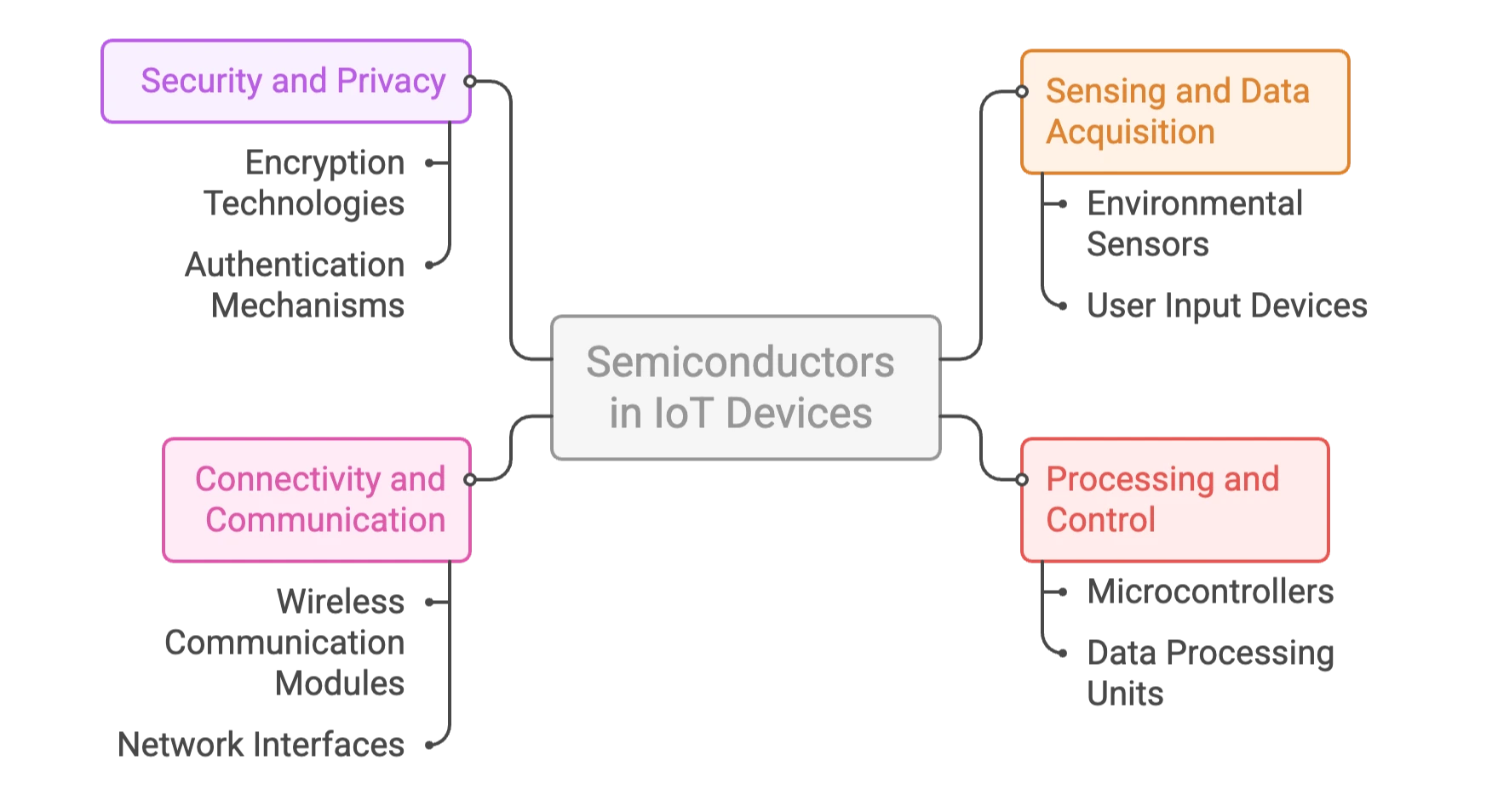
Semiconductors play a crucial role in enabling the functionalities of IOT devices. Let’s look closer at their specific contribution to those devices-
Sensing and data acquisition
Semiconductor-based sensors are essential components in IOT applications for data collection. They can promptly detect various environmental parameters like temperature, light, motion, and pressure. They detect and then convert these data or physical quantities into electrical signals.
- Precision Analog Front-Ends (AFEs): Modern sensors use AFEs to clean, amplify, and digitize signals with extreme accuracy before they even reach the main processor.
- MEMS Technology: Micro-Electro-Mechanical Systems (MEMS) allow for the miniaturization of high-performance motion and pressure sensors used in wearables.
Processing and control
The brain of IOT devices are microcontrollers and microprocessors which are powered by semiconductor technology. The semiconductor chips interpret the data received from the sensors, execute programmed instructions, and then make real-time decisions. Actuators are devices that convert electrical signals back into physical quantities or actions that proceed with tasks like adjusting room temperature based on sensor data, or trigger alarms when anomalies are detected. The functionality of the processor unit in IOT devices depends on the specific requirements of the respective device. Devices with simple sensing activities might utilize low-power microcontrollers, while complex IOT devices leverage the advanced processing capabilities of microprocessors.
Connectivity and communication
Semiconductors with their advanced functionality facilitate communication between IOT devices and other systems of the network. Wireless communication modules such as Wi-Fi, Bluetooth, and cellular radio chips are all built using semiconductors. These modules enable data transmission between devices and gateways or cloud platforms that validate remote monitoring, control, and data analysis.
Security and privacy
Security is the most concerning aspect in the interconnected world of IoT. Thus semiconductor companies are moving forward to incorporate security measures in semiconductors. They are developing chips with built-in security features such as encryption engines and secure boot capabilities. These features are developed to safeguard sensitive data collected by IOT devices as well as prevent the situations of potential security risks.

Innovations In IOT Devices Driven By Semiconductor Companies
Semiconductor companies across the globe, including semiconductor company in USA like Intel, are constantly making efforts to make innovative developments in chip technology that cater to the advancing requirements of the IOT market. They are making heavy investments in the research and development (R&D) department to design revolutionized chips. Those chips aim to be built smaller in size, more energy-efficient, and more powerful semiconductors to address the growing need for IOT applications.
Key Innovations and Design Considerations
Semiconductor leaders like NVIDIA, Intel, and NXP are revolutionizing chip technology to meet the specific needs of the IoT market:
- Power Efficiency (Wide Bandgap Materials): New materials like Gallium Nitride (GaN) and Silicon Carbide (SiC) are replacing traditional silicon in power management. They offer up to 30% higher efficiency and can handle higher voltages, significantly extending the battery life of remote sensors.
- Size and Form Factor (3D IC Stacking): Innovation in 3D stacking and Advanced Packaging now allows different chips to be integrated vertically. This reduces the footprint of the electronics while increasing I/O density by up to 100x.
- Cost-Effectiveness: Manufacturing optimization at smaller process nodes (down to 3nm) helps drive the mass adoption of inexpensive consumer IoT devices like smart bands.

The Future Of Semiconductors And The Internet of Things (IoT)
When it comes to the future aspect of semiconductors and IoT then it is intertwined. Since the demand for IOT devices is surging, top semiconductor company like TSMC are striving to provide innovative chip solutions to validate the efficient functioning of IoT devices. Some of the potential areas of development are:
- Artificial intelligence integration: The integration of AI gaining popularity in every industry to enhance efficiency. Through specialized hardware like neuromorphic chips AI capabilities can be directly embedded into IOT devices. It enables on-device data processing and intelligent decision-making at the edge of the network.
- Security enhancements: Cases of security breaches are growing with alarm rate hence security concerns become paramount in the semiconductor industry. Semiconductor companies are developing chips with advanced security features to safeguard data and enhance protection against cyberattacks.
- Emerging semiconductor technologies: New materials like gallium nitride (GaN) and advanced fabrication techniques like three-dimensional (3D) chips hold opportunities to provide smaller, faster, and more efficient solutions to IOT devices.
Sustainability in Semiconductor Engineering: Advancement and Innovations
Concluding Remark
When it comes to the future aspect of semiconductors and IoT then it is intertwined. Since the demand for IOT devices is surging, top semiconductor company like TSMC are striving to provide innovative chip solutions to validate the efficient functioning of IoT devices. Some of the potential areas of development are:
It is quite clear that semiconductors play a vital role in IoT and smart devices through their modernized chip-designing technology. They are like the invisible driving forces of this smart world. In this semiconductor companies are playing their part by proposing and creating innovative chip solutions for advanced electronic devices and systems. Tessolve is a leading semiconductor company who have the same goal as other leading companies i.e. offering efficient and reliable chip solutions to their customers to create impact.
Frequently Asked Questions
Q1: Why is Edge AI important for IoT semiconductors?
It allows devices to process data locally, ensuring real-time decision-making, better privacy, and significant savings in battery life and bandwidth.
Q2: What is Gallium Nitride (GaN) and Silicon Carbide (SiC)?
These are “Wide Bandgap” materials that enable smaller, faster, and more energy-efficient power conversion than traditional silicon chips.
Q3: How does 3D IC technology help smart devices?
By stacking chips vertically, 3D ICs pack more processing power and memory into tiny spaces, perfect for compact wearables.
Q4: What makes a semiconductor “Secure by Design”?
It includes dedicated hardware security cores and encrypted storage that protect the device from the moment it boots up.