
Time is money, and it must never be wasted. This aphorism applies to everything, including embedded system technology. For this reason, System-on-Modules are so popular right now since they provide all the capabilities you need without requiring you to design, locate, and assemble the components yourself. In 2026, the demand for “Edge AI” and rapid prototyping has made SoMs the industry standard for high-performance product development. If this is something new for you, don’t worry. At Tessolve, our team of embedded system development experts is here to help you with the essential guide to understanding SoMs.
What is a System on Modules?
Before delving into any other details, let’s start from the beginning. A module system comprises a small package with all the significant elements of an integrated processing system. This includes everything from processor cores, communication configurations, and memory blocks on a small, production-ready Printed Circuit Board (PCB). Modern SoMs often adopt standardized form factors like SMARC or Qseven to ensure scalability. A System on Modules is a complete CPU architecture in one tiny container. This approach allows SoM to be embedded in end systems ranging from complicated robots to simple home security cameras.
However, a System on Module should not be confused with a System on a Chip (SoC). An SoC includes a series of crucial compute components, all assembled on one chip. On the contrary, an SoM is based on a board and can include multiple components, and an SoC can be one of these. Think of the SoC as the “brain” and the SoM as the “entire nervous system,” ready to be integrated into your application.
Blade servers initially led to the development of the system on modules. These small servers were developed to conserve energy use and save storage space. The SOM assembly has been designed in the same sleek style as blade servers, and only the elements necessary for operation are all together in one tiny package. Tessolve provides an extremely integrated software and hardware platform developed for quick advancement and accelerated time-to-market, along with an assortment of resources and tools for ease of maintenance and scalability of design.
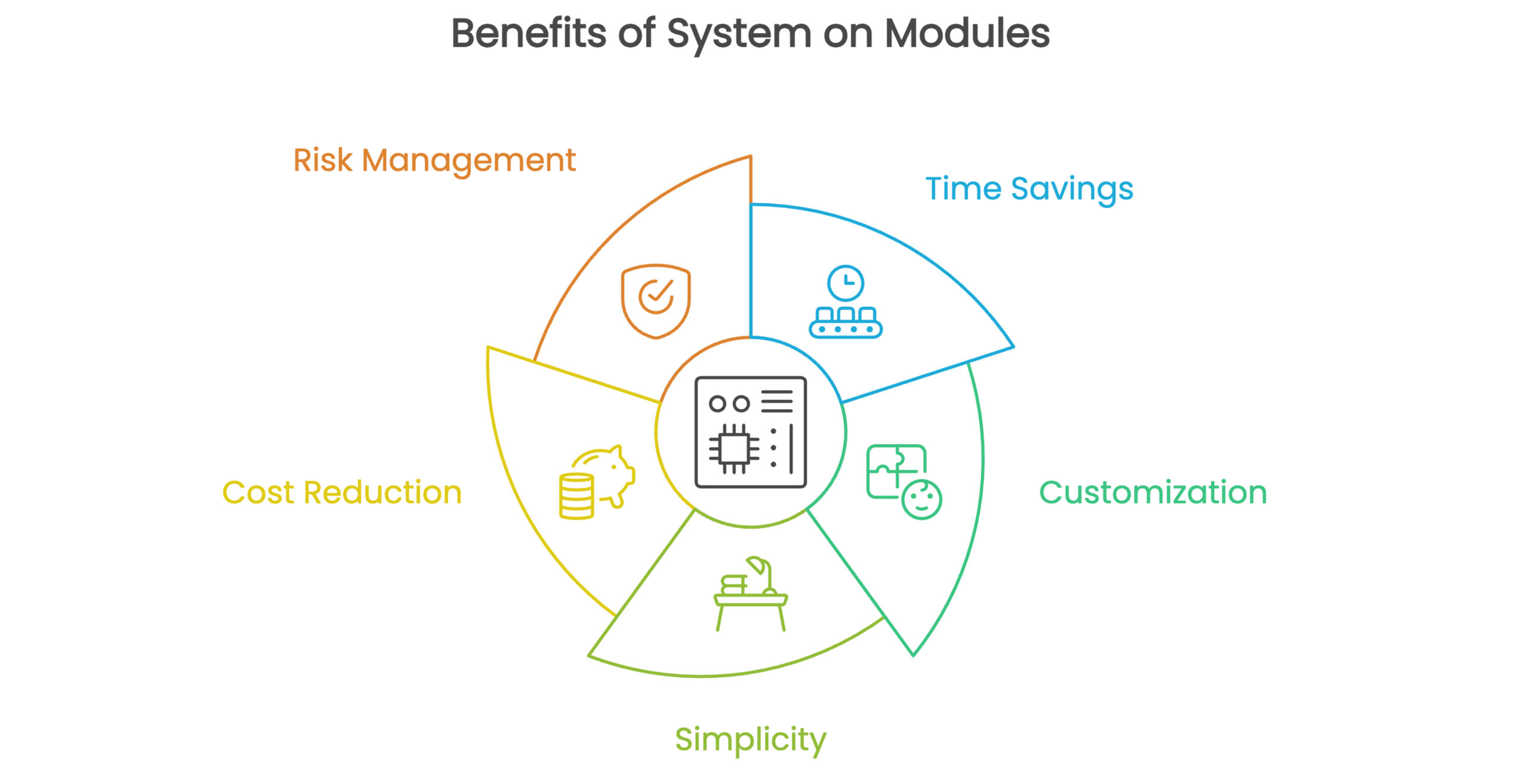
Five Reasons to Use System on Modules (SoM) in Embedded System Design
Now that you understand what system on modules is, let’s start discussing why they must be used in embedded systems:
1. Saves time
The primary reason behind the usage of the system on modules for the embedded device is the time-saving aspect. It takes far less time to build a product based on an SoM than to design a complete system from the start. Creating the CPU infrastructure, especially with high-speed DDR5 memory and complex signal integrity requirements, often takes the most effort. Tessolve provides the best-in-class, reliable, and secure embedded SOM solution with integrated wireless connectivity.
2. Customization
System on Modules provides a wide range of features and processor speeds in the same packages. This allows businesses to provide the same carrier board with variable speeds. This “Pin-Compatible” approach means you can upgrade your product’s performance without redesigning the base hardware. Customers can easily design custom carrier boards that meet all their requirements without individually thinking about the processor and memory.
The issue related to complicated custom cables is also eliminated since most businesses will provide pre-wired connectors that match standard cables. With the help of simple process upgrades and downgrades, anyone can create their dream system without spending their entire budget and a lot of time.
3. Simplicity
Another significant reason is the advancement of semiconductor technologies. Designing an embedded system using a SoC or FPGA requires a significant amount of time and care. Since semiconductors are becoming more and more advanced, there is a lot of information and little nuances to consider during the design process. Instead, one can use an SoM and spend the rest of the time focusing on the personality of your product and taking advantage of the complexity.
4. Lower Development and Total Ownership Cost (TCO)
While an SoM has a higher unit cost than a raw SoC, it significantly reduces engineering expenses. You save on high-end PCB fabrication, expensive testing equipment, and specialized engineering labor. Furthermore, the risk of “design spins” (costly PCB re-designs) is almost entirely eliminated.
5. Risk at the end of its useful life
The complications related to the end-of-life product based on a flash chipset or an end-of-life CPU are minimized by using a system of modules. The system may be brought back to life with a simple switch without significant carrier board changes. In addition, customers won’t have to worry about spending a lot of money on boards every year since most SoMs have a lifespan of more than five years.
You can obtain reliable SoMs from Tessolve as we also provide evaluation boards for SoM. Tessolve allows faster time to market for customers by offering a seamless shift from development to production and more.
Software and hardware development
Systems on modules can help achieve edge computing and local data processing without latency. This eliminates the requirement for expert hardware knowledge and experience by providing an intuitive design that anyone can apply. In addition, software developers who interfere with vision applications will appreciate the easily configurable sensors provided by SOMs.
Any hardware developer knows that production needs to be completed as quickly as possible, so limited resources should be focused on the highest-impact tasks. A system on modules provides field-programmable gate array (FPGA) performance and flexibility without all the hassle of PCB design and integration. With a powerful and innovative industrial System-on-Modules, integrated security, sophisticated device management tools and systems software, Tessolve’s embedded solutions minimize the expense of ownership and aid propel OEMs to success in the market.
Security cameras
One of the most common applications of SoMs is security cameras. Many system-on-modules provide 4K vision and video processing capabilities, which makes them ideal for such types of applications. These security cameras not only record videos but also use machine learning to categorize and analyze what they see, consistently delivering accurate real-time data.
Wrapping Up
System-on-Modules are the future of embedded systems development. Some of the examples listed above are just a few of hundreds of applications. Especially during the pandemic, home automation is high on people’s priority list, and most of these embedded devices are made with SoM.
Tessolve has its independent SOM Module Family, MAGIK-2 models, depending on the SMARC/Q7 standard, consisting of an entire software suite involving Device Drivers, assistance for different operating systems permitting efficient productization. SoM by Tessolve supports standard Android SDK that can be personalized for product development needs. Our System-on-Modules solutions and services permit customers to initiate their software development before manufacturing and assists in quick marketing.
Head over to Tessolve and check out our SoMs to start building your dream system today! For better assistance from our experienced engineers, email us today sales@tessolve.com
From Concept to Prototype: The Complete Embedded System Design Process
Frequently Asked Questions
1. What is the main difference between an SoM and a Single Board Computer (SBC)?
An SBC is a standalone “ready-to-use” board (like a Raspberry Pi), while an SoM must be plugged into a carrier board to function.
2. Can I use an SoM for AI and Machine Learning applications?
Yes, modern SoMs feature integrated AI accelerators (NPUs) specifically designed to handle complex vision and data processing at the edge.
3. What is a “Carrier Board”?
It is a custom PCB that provides the physical connectors (USB, HDMI, Ethernet) and power for the System-on-Module.
4. How does using an SoM reduce project risk?
It uses pre-tested, high-speed circuitry, ensuring that the “heart” of your system is guaranteed to work before you even start your design.