For decades, System-on-Chip (SoC) designs dominated the semiconductor landscape. The goal was to integrate as many functions as possible onto a single monolithic die while leveraging Dennard scaling to improve performance. However, changes in physics, economics, and time-to-market pressures have transformed the industry. Enter chiplet architectures: these are composable systems made up of multiple smaller dies packaged together. This new approach is redefining the development strategies of leading semiconductor companies and design firms, as well as the field of semiconductor engineering as a whole.
Why Chiplets, Why Now?
Three forces converged. First, reticle limits mean you can’t print chips beyond a certain area in one exposure, historically ~26 mm × 33 mm (≈858 mm²). That cap conflicts with increasing logic counts, wide memory interfaces, and larger accelerators.. Second, the cost curve at advanced nodes is steep; moving all IP to the newest node can be overkill. Third, time-to-market favors reuse and parallel development across teams and suppliers. Chiplets answer all three: break functions into smaller dies, place each on the optimal process, and integrate them into a package. This approach also enables faster product customization, improved supply chain flexibility, and easier integration of specialized AI, memory, and I/O chiplets into a single package.
For a top semiconductor company, this means higher yield (smaller dies fail less often), mix-and-match process nodes (e.g., leading-edge logic beside mature analog), and faster iteration cycles. For a semiconductor design company, modularity enables differentiated products derived from common chiplet libraries. And for semiconductor engineering, the focus expands from single-die closure to multi-die integration, packaging, and system architecture.
The Role of Chiplets in Semiconductor Design: A Modular Approach
The Interconnect That Makes It Click
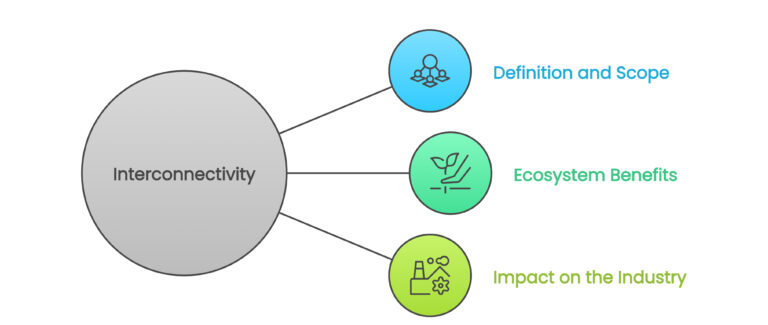
A modular system, such as chiplets, relies on seamless communication between dies. This is where Universal Chiplet Interconnect Express (UCIe) becomes a game-changer. A successful chiplet architecture depends on fast, reliable die-to-die communication. This is where Universal Chiplet Interconnect Express (UCIe) has emerged as an industry-standard interconnect, enabling interoperability across chiplets from different vendors. Key aspects of UCIe:
1. Definition and scope
- Standardizes the die-to-die physical layer, protocols, software model, and compliance.
- Enables high-bandwidth, low-latency communication across organic substrates, 2.5D interposers, and 3D stacks.
2. Ecosystem benefits
- Creates an open marketplace for “plug-and-play” chiplets.
- Supports interoperability among vendors, driving faster innovation and broader adoption.
3. Impact on the industry
- For a semiconductor design company, it shifts sourcing from in-house macro blocks to externally sourced, pre-verified chiplets with hardened PHYs and known-good-die (KGD).
- For semiconductor engineering, it redefines verification boundaries, requiring system-level validation rather than only single-die testing.
- For a top semiconductor company, it reduces integration risks, shortens time-to-market, and enhances scalability.
Packaging is the New Performance
Chiplets depend on advanced packaging to deliver performance, scalability, and efficiency.
Key packaging approaches:
- 2.5D Interposers – high wiring density, ideal for HBM proximity.
- 3D Stacking – shorter interconnects, higher bandwidth, better efficiency.
- Fan-Out Packaging – extends beyond single-reticle limits, enabling large GPUs, AI accelerators, and memory-rich devices.
- Advanced Hybrid Bonding – enables ultra-high-density die-to-die connections with lower latency, lower power consumption, and improved bandwidth for next-generation AI and HPC processors.
Engineering priorities:
- Signal Integrity – mitigate crosstalk and skew and ensure high-speed die-to-die performance.
- Chiplet Reliability – managing package stress, die Warpage, and long-term reliability across heterogeneous chiplets.
Why it matters:
For any top semiconductor company, co-optimizing packaging, interconnect, and power delivery is now as critical as process node selection. These are central semiconductor engineering tasks, not secondary concerns.
Architectural Freedom
Chiplets unlock new partitioning strategies:
- Heterogeneous integration: Pair bleeding-edge CPU tile(s) on N3/N2 with analog, RF, or I/O chiplets on cost-effective nodes, delivering value without monolithic migration.
- Scalable products: Reuse a compute die across SKUs, varying only I/O or memory tiles to address market tiers.
- Domain specialization: Dedicated acceleration tiles for AI, security, or video offload that can evolve at their own cadence.
Constraints exist. Latency and energy per bit across die-to-die links aren’t free; software and firmware must account for topology. Cache coherency across chiplets, especially with heterogeneous memory hierarchies and disaggregated accelerators, requires careful protocol selection and quality of service. And supply-chain complexity rises: more parts, more test flows, and more vendors.
Verification, Test, and KGD
Verification moves from single-die closure to system-level proof across chiplet boundaries. Pre-silicon emulation must model die-to-die behavior; post-silicon validation needs new bring-up sequences and observability points across tiles. Design-for-Test (DFT) extends to inter-die links, loopbacks, boundary scan, and Built-in Self-test (BIST) for KGD assurance, because one bad chiplet can sink a whole module.
Advanced pre-silicon emulation, digital twins, and AI-assisted validation are increasingly being used to identify inter-chiplet issues before fabrication. A semiconductor design company that masters robust KGD flows, interconnect characterization, and multi-die ATPG gains a time-to-yield advantage. It’s exactly where the differentiation frontier sits today for a top semiconductor company executing volume programs.
Economics and Roadmaps
Chiplets rewrite the BoM and roadmap math. Yes, packaging and assembly costs rise, and yield interactions can complicate forecasting. But smaller dies at optimal nodes usually offset losses from monolithic reticle-edge designs, while SKU reuse amortizes NRE across a portfolio. The result is faster feature evolution, SKU agility, and lifecycle extensions by swapping in refreshed chiplets instead of respinning a massive SoC.
For teams practicing semiconductor engineering, that means earlier co-design between architecture, packaging, test, and operations, and tighter partnerships with OSATs, EDA vendors, and interconnect IP suppliers. This modular development model also shortens product refresh cycles and allows manufacturers to respond faster to changing market requirements.
What to Do Next
- Adopt standards early. Target UCIe-compliant PHYs/links to de-risk multi-vendor integration.
- Invest in package-aware design. Elevate PI/SI/thermals to first-class citizens during partitioning.
- Industrialize KGD. Strengthen DFT/DFD for die-to-die observability and rapid bring-up.
- Build reusable chiplet libraries. Treat tiles as products with roadmaps, not just one-off program artifacts.
Adopt UCIe-ready design flows early to simplify future multi-vendor chiplet integration.
Do this, and your organization, whether a semiconductor design company or an aspiring top semiconductor company, can move from monolithic complexity to modular velocity.
3D ICs, Chiplets & HBM: How Packaging Is Driving the Semiconductor Roadmap
Why Tessolve for Chiplet-Era Programs
At Tessolve, we provide comprehensive silicon solutions that seamlessly integrate with chiplet workflows. Our services cover all stages of chip design, from RTL to GDSII, including Design for Test (DFT), Automated Test Equipment (ATE) development, product engineering, post-silicon validation, reliability qualification, and embedded/system design for multi-die systems.
Our VLSI teams specialize in analog, digital, mixed-signal, and RF designs. Our test engineering experts expedite the transition from prototype to high-volume production. Our labs focus on reducing reliability risks, while our embedded systems professionals integrate hardware, firmware, and connectivity to create complete products.
Supported by rigorous quality systems and active partnerships within the ecosystem, we empower you to confidently partition designs, validate quickly, and scale reliably across advanced packages and UCIe-class interconnects.
Frequently Asked Questions
1. What is chiplet architecture in semiconductor design?
Chiplet architecture combines multiple smaller semiconductor dies into one package, improving scalability, performance, manufacturing yield, and design flexibility.
2. How does chiplet architecture change semiconductor design workflows?
It enables modular design, IP reuse, advanced packaging, multi-die verification, and faster product development across different process nodes.
3. What is the reticle limit in semiconductor manufacturing?
The reticle limit is the maximum chip size printable in one lithography exposure, encouraging chiplet-based designs for larger systems.
4. What are the benefits of modular chiplet design?
Modular chiplet design improves yield, reduces development costs, enables process-node flexibility, accelerates time-to-market, and simplifies product customization.
5. What should you consider when choosing chiplet integration solutions?
Choose solutions supporting UCIe, advanced packaging, reliable die-to-die connectivity, strong validation capabilities, and scalable manufacturing for future designs.