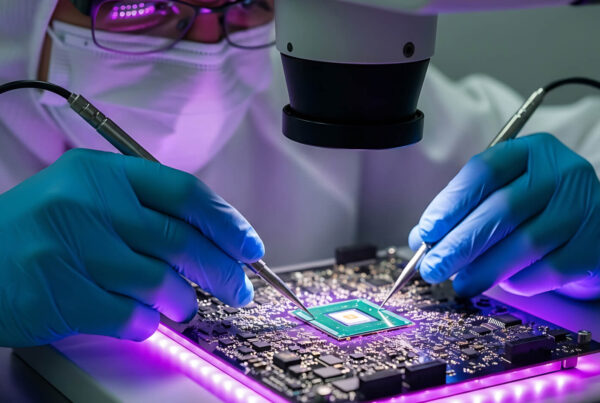

Computing progress has always been driven by one critical foundation: semiconductors. From everyday smart devices to advanced artificial intelligence systems, continuous chip innovation powers modern technology. As performance, efficiency, and scalability demands grow, semiconductor design is becoming increasingly sophisticated.
Advancements in 2nm and sub-2nm nodes, 3D-IC chiplet architectures, and ultra-high-speed interconnects are enabling a new generation of high-performance computing systems.
These developments are not just enhancing existing technologies; they are reshaping how computing systems are built and scaled across industries.
The Evolution of Semiconductors
Semiconductors have indeed come a long way from where they started. From simple devices applied in merely simple electronic components, with the advancement of technology, they grew complex with their capabilities. Today, semiconductors are at the heart of practically every electronic gadget, from consumer electronics to industrial machinery.
Another huge step in semiconductor technology was the invention of the Integrated Circuit (IC) in the 1950s. The realization of this structure allowed the miniaturization of electronic components on smaller and more powerful devices. From then on, semiconductors continued to evolve in materials, design, and manufacturing.
Modern semiconductor evolution now includes highly integrated systems combining logic, memory, and interconnects within compact architectures. Since then, semiconductors have continued to evolve in materials, design, and manufacturing processes.
Moore’s Law and Beyond
In effect, Moore’s Law has, for many decades, represented the driving force of semiconductor improvements by supposing a two-yearly doubling of the number of transistors on each chip. With such enormous growth in transistor density, rapid development has been possible with respect to more powerful yet efficient computers. As this technology approaches its physical limit with traditional silicon semiconductors, the industry faces new hurdles in maintaining innovation at this pace.
Today, the industry is advancing toward 2nm and sub-2nm nodes, where quantum effects, power density, and variability become critical design considerations. Almost every top semiconductor company is investing in parallel to find alternative materials and methods to meet the demand for smaller, faster, and more energy-efficient chips. For instance, SiC (silicon carbide) and GaN (gallium nitride) have emerged as promising materials that outperform conventional silicon for specific tasks, especially in power electronics and high-frequency devices. In addition to material innovation, advanced lithography and new transistor architectures are enabling continued scaling beyond traditional limits.
Artificial Intelligence and Machine Learning
AI and ML technologies have brought challenges and opportunities for the semiconductor industry. Since these technologies require immense computational power, they have driven the need for unique semiconductor designs. AI and ML workloads are mostly parallel, while traditional CPU architectures are poorly suited for these tasks. This has driven the sudden growth in the development of chips for AI, including graphics processing units (GPUs), tensor processing units (TPUs), and neuromorphic chips.
Modern semiconductor design increasingly incorporates AI-driven optimization, including AI-assisted PPA (Power, Performance, Area) tuning and intelligent workload acceleration.
Several semiconductor design companies are leading this shift by developing custom chips optimized for AI and ML applications. These chips are designed to handle large-scale data processing while maintaining energy efficiency.
AI is also being used within chip design workflows, including Agentic AI for EDA automation and machine learning models for predictive design optimization.
Quantum Computing
Quantum computing is yet another frontier that holds immense promise for the future in computing. While classical computers represent data by bits, either 0 or 1, quantum computers are based on qubits, which can represent 0 and 1 simultaneously. This superposition property allows quantum computers to execute complex calculations at speeds that no classical computer of today could dream of.
Although still in early stages, major semiconductor companies are investing heavily in quantum research. Advancements in quantum hardware, materials, and error correction techniques are steadily improving the feasibility of scalable quantum systems. Quantum computing has the potential to transform industries such as cryptography, drug discovery, and material science.
The Emergence of 3D Chip Stacking
3D chip stacking is one of the most significant advancements in semiconductor technology. Traditionally, chips were designed in a two-dimensional layout. However, physical scaling limitations have led to the adoption of vertical integration. In 3D chip stacking, multiple layers of transistors are stacked vertically, increasing performance while reducing footprint.
This approach is closely aligned with modern 3D-IC chiplet architectures, where multiple dies are integrated into a single package for improved performance and scalability. It enables higher performance, lower power consumption, and improved efficiency.
Advanced interconnect technologies and high-bandwidth interfaces (such as ultra-fast SerDes links) further enhance communication between stacked dies. Many semiconductor design companies are adopting this approach to overcome scaling challenges and achieve higher system-level performance.
How Tessolve Accelerates Semiconductor Innovation
With its continuous drive to innovate, Tessolve has grown into a leading semiconductor design and testing company, playing a critical role in shaping the future of computing. Backed by expertise across design, verification, and validation, Tessolve supports companies in achieving faster time-to-market and higher reliability.
Its semiconductor design services help companies with chip design, hardware-software co-design, and system integration for developing advanced solutions.
By leveraging modern design methodologies and advanced verification techniques, Tessolve helps address the complexity of next-generation semiconductor systems.
In addition, Tessolve provides end-to-end semiconductor testing solutions to ensure quality and performance across a wide range of applications, including AI-driven systems and high-performance computing devices.
The Role Of Semiconductors In IoT And Smart Devices
Let’s Sum Up
Bright days are ahead in computing, and all this will be possible thanks to advances in semiconductor technology. From chips made specifically for AI to quantum computing to 3D stacking of chips, possibilities could be endless. Top semiconductor companies are at the heart of leading this revolution through continuous innovation. Meanwhile, every semiconductor design company, as well as a semiconductor testing company, plays a very important role in ensuring they work properly.
Looking ahead, collaboration and innovation represent two leading imperatives that will determine the semiconductor industry’s future shape. Only through collaboration can the industry continue to enable the future of computing, enabling new applications and changing how people live and work. The speed of change is continually increasing, with no indication of deceleration. The logical next step for companies committed to staying ahead is to partner with the best semiconductor company to leverage its design services.
Tessolve: Empowering the Future of High-Speed PCB Design
At Tessolve, we understand what it takes to engineer reliable, high-speed systems in today’s rapidly evolving electronics landscape. With deep expertise in high-speed SerDes design, advanced stackup engineering, controlled impedance routing, SI/PI simulation, validation, and end-to-end hardware execution, we help global customers build performance-driven boards with confidence. Our Tessolve teams combine engineering excellence with strong lab infrastructure, compliance knowledge, and manufacturing alignment to deliver designs that perform, scale, and succeed in real-world deployment. Whether you’re pushing data rates higher, simplifying complexity, or accelerating development cycles, Tessolve stands as your trusted partner for robust, future-ready PCB innovation.
Frequently Asked Questions
1. How can complex technology breakthroughs be effectively positioned?
Complex breakthroughs should be explained with clear context, real-world applications, and simplified insights, helping stakeholders understand their impact without overwhelming technical complexity.
2. What are the latest advancements in semiconductor technology?
Recent advancements include smaller process nodes, chiplet architectures, 3D integration, advanced materials, and high-speed interconnects that improve performance, efficiency, and scalability.
3. What role does computational software play in semiconductor manufacturing?
Computational software enables simulation, modeling, and optimization of chip designs and manufacturing processes, reducing errors, improving yield, and accelerating development cycles.
4. How are AI and semiconductors driving innovation?
AI enables smarter chip design and optimization, while advanced semiconductors provide the computing power needed to run complex AI workloads efficiently.
5. What are the most important advancements in chip management?
Key advancements include improved power management, thermal control, workload optimization, and intelligent resource allocation to enhance chip efficiency, reliability, and performance.