In the rapidly evolving landscape of digital connectivity, the importance of wireless testing has witnessed exponential growth. The proliferation of wireless technologies across industries and the increasing dependence on seamless communication underscore the critical role of comprehensive testing strategies. As we enter 2026, the global rollout of 5G-Advanced and the full-scale adoption of Wi-Fi 7 (IEEE 802.11be) have introduced ultra-wide 320MHz channels and 10 Gbps throughput, making precision testing a non-negotiable requirement.
For instance, wireless testing in PCB and hardware design is a crucial phase that ensures the reliability, performance, and security of wireless communication systems. In this blog, we will discuss the growing importance of wireless testing and some of the significant testing strategies associated with it.
Understanding the Concept of Wireless Testing and its Growing Importance
Wireless testing is a critical process that ensures the functionality, security, and performance of wireless communication systems and devices. With the commercial maturation of 5G-Advanced, testing must now account for “deterministic low latency” in industrial robotics and high-fidelity XR (Extended Reality) applications.
- Advancements in wireless standards increase complexity in ecosystems. Testing becomes essential to validate compatibility and performance across a diverse array of devices and protocols. Furthermore, antenna testing is crucial in PCB board design. Wireless testing helps ensure that the placement of antennas is optimal for achieving desired performance. In modern sub-6 GHz and mmWave designs, “Antenna-in-Package” (AiP) technology requires specialized Over-the-Air (OTA) validation as traditional cable-based testing is no longer physically possible.
- The concept of the Internet of Things (IoT) is significantly growing in the number of connected devices. Hence, wireless testing becomes instrumental in ensuring that these devices can seamlessly communicate with each other, maintaining interoperability and safeguarding against potential security vulnerabilities.

Key Aspects: Functionality, Security, Performance, & Interoperability
Wireless Compatibility Testing
Verify that the device operates on its designated frequency spectrum without causing interference to other devices or being susceptible to interference from other devices. It tests the device’s ability to share the frequency spectrum with other wireless systems without degrading its performance. It helps evaluate how well the device handles interference from other wireless devices or networks. This involves assessing the impact of external signals on the device’s signal quality and overall performance.
For example; Wireless Compatibility Testing in PCB design is a critical phase aimed at ensuring that electronic devices can function seamlessly in environments with various wireless technologies, networks, and devices.
Wireless Interoperability Testing
Wireless Interoperability Testing is a critical phase in the development of wireless-enabled devices and networks. It focuses on ensuring that different devices, technologies, and systems can communicate and work together seamlessly, promoting a cohesive and interconnected wireless ecosystem. It assesses interoperability across various operating systems to ensure consistent performance. It is fundamental to creating a connected and collaborative wireless environment.
Functional Testing
This verifies adherence to wireless communication standards (like 3GPP Release 18/19). Functional testing now includes “Network Slicing” validation, ensuring that a single physical network can provide dedicated performance for critical tasks like autonomous driving while simultaneously handling standard consumer traffic.
Future Trends in Wireless Testing
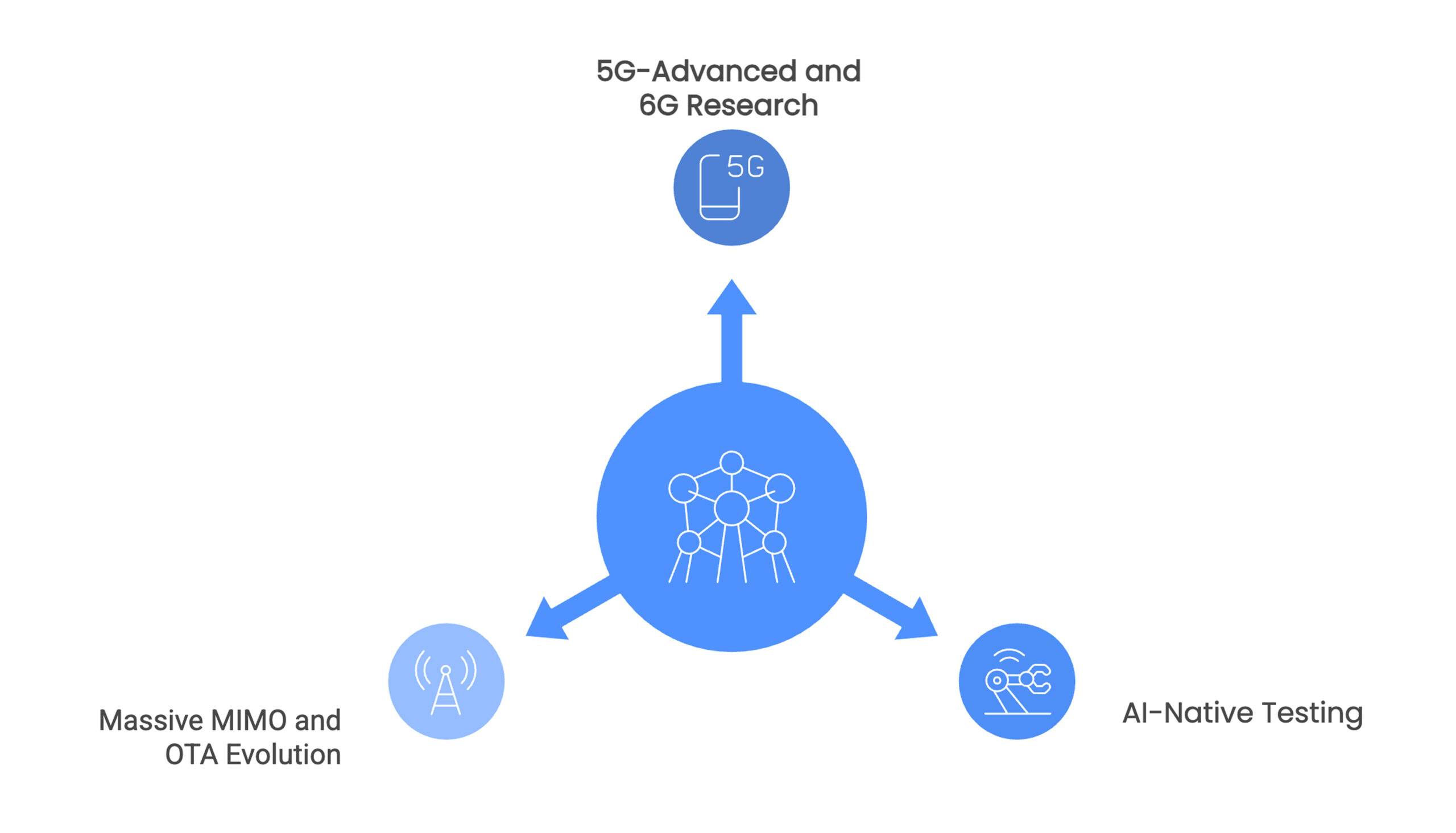
- 5G-Advanced and 6G Research: With commercial 5.5G deployments, testing strategies now focus on mmWave frequencies up to 71 GHz. Simultaneously, 6G research has moved into the Terahertz (THz) spectrum (sub-300 GHz), requiring specialized anechoic chambers with micron-level positioning accuracy.
- AI-Native Testing: AI and ML are no longer just for analysis; they now natively power the air interface. “Agentic AI” tools are used in labs to automate the generation of millions of test cases, identifying “edge-case” failures that human engineers might overlook.
- Massive MIMO and OTA Evolution: The use of broader bandwidths necessitates Compact Antenna Test Range (CATR) anechoic chambers. These chambers allow for Over-the-Air (OTA) testing of devices in a controlled far-field environment, measuring gain, efficiency, and beam characteristics.
Benefits of Wireless Testing
Identification of Weaknesses:
Testing helps identify potential weaknesses and performance bottlenecks in wireless networks, allowing for optimization before deployment.
End-to-End Testing:
Ensures that the entire wireless communication chain, from devices to networks, meets the required quality standards.
Cost-Efficiency and Risk Mitigation:
Identifying and addressing issues during the testing phase is more cost-effective than resolving problems after deployment. Hence, it mitigates the risk of expensive post-deployment fixes and potential negative impacts on business operations.
Ensuring Standards Compliance and Interoperability:
Wireless testing is crucial for validating functionality, interoperability, standards compliance, and certifying wireless devices and networks. Thorough testing across protocol layers ensures features work correctly per specifications for certification. It verifies interoperability between different vendors, networks, and devices operating together. Standards bodies mandate extensive testing for compliance.
Indian Operators into 5G Wireless Network
Choose Tessolve: A Reliable Platform for Semiconductor Solutions
In the dynamic landscape of wireless technologies, thorough testing is indispensable to guarantee the reliability, security, and performance of wireless networks. For instance, hardware design is one of the critical and foundational aspects for any technology to work comprehensively. Wireless technology has become an integral part of modern PCB and hardware design, enabling a wide range of applications from IoT devices to smartphones and wearables.
Tessolve is renowned for providing robust semiconductor solutions. We provide a range of solutions, including PCB design. We have 15,000 Sqft. lab that houses the latest test engineering equipment for both the final test and wafer sort. For robust and excellent semiconductor solutions, engage with us today!
For better assistance from our experienced engineers, email us today at sales@tessolve.com.
FAQs
What solutions exist for wireless conformance testing?
Industry leaders like Anritsu (MT8000A) and Rohde & Schwarz provide 3GPP-compliant platforms for automated RF, protocol, and RRM validation.
What type of device can be used to assess the quality of a wireless signal?
Spectrum and Vector Signal Analyzers (VSA) are used to measure signal strength, frequency accuracy, and Error Vector Magnitude (EVM).
What’s the best setup for testing wireless communication modules?
A robust setup includes a shielded anechoic chamber, signal generators, and network emulators to simulate real-world interference and connectivity.
What is “Coexistence Testing” in a Wi-Fi 7 environment?
It ensures that Wi-Fi 7, which uses wide 320MHz channels, can operate alongside 5G and Bluetooth without causing data drops or signal interference.
How does AI improve wireless testing efficiency?
AI automates the analysis of complex signal patterns and predicts failure points, reducing the time required for manual debugging by up to 40%.