India has rapidly emerged as one of the world’s fastest-growing 5G markets. With widespread deployment by major telecom operators, 5G is enabling faster connectivity, lower latency, and new digital services across industries such as manufacturing, healthcare, automotive, smart cities, and Industry 4.0. As adoption continues to grow, telecom operators are expanding network coverage while preparing for future advancements such as 5G Advanced and the evolution toward 6G.
Introduction to 5G Technology
5G technology is the fifth-generation mobile network that delivers faster speeds and lower latency than its predecessors. The technology uses higher frequencies, greater bandwidth, and advanced antenna technology to deliver better connectivity and faster download and upload speeds.
Indian telecom operators have significantly expanded their 5G infrastructure, accelerating nationwide deployment and supporting enterprise digital transformation. Reliance Jio, Bharti Airtel, and Vodafone Idea are the three major players in the Indian telecom industry, and all three are actively working towards deploying 5G networks.
Reliance Jio
Reliance Jio has emerged as a leader in India’s 5G rollout with one of the world’s largest Standalone (SA) 5G networks. The company has deployed an indigenous 5G core, expanded coverage across cities and towns, and introduced services such as JioAirFiber to deliver high-speed wireless broadband. Jio also continues to invest in enterprise 5G, private networks, and AI-driven digital infrastructure.
Bharti Airtel
Bharti Airtel has significantly expanded its 5G services across India through its Airtel 5G Plus network. Using a Non-Standalone (NSA) architecture, the company continues to enhance network coverage, improve customer experience, and support enterprise applications. Airtel is also investing in cloud connectivity, private 5G solutions, and advanced digital services for businesses.
Vodafone Idea
Vodafone Idea is expanding its commercial 5G services in key Indian cities while modernizing its network infrastructure. The company continues to invest in spectrum, network upgrades, and strategic technology partnerships to strengthen its 4G and 5G offerings. Its phased rollout focuses on improving customer experience while supporting future digital transformation initiatives.
Availability of Spectrum
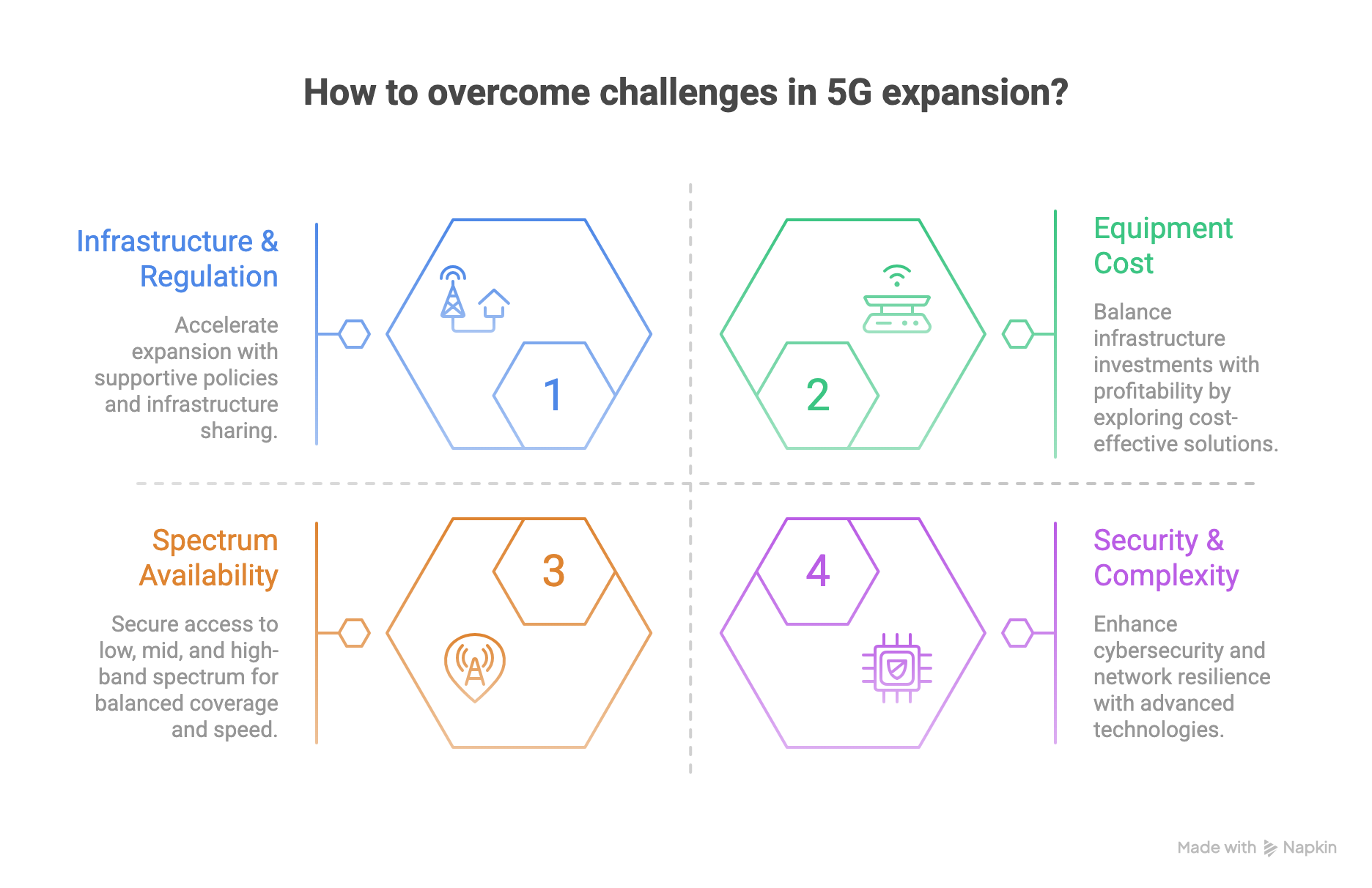
India has conducted several spectrum auctions, but effective spectrum utilization and the availability of additional spectrum are still crucial for expanding 5G coverage and for future technologies like 5G Advanced. Telecom operators need access to low, mid, and high-band spectrum to provide a balanced approach to coverage, capacity, and ultra-fast data speeds across various deployment scenarios. Continued spectrum planning and regulatory support will help operators improve network performance and meet growing data demands.
High Cost of Equipment
Despite wider deployment, the high cost of expanding and upgrading 5G infrastructure remains a major challenge for telecom operators. Modern 5G networks require advanced radios, Massive MIMO antennas, Open RAN-compatible equipment, edge infrastructure, and fiber backhaul, all of which require significant investment. Balancing infrastructure investments with profitability remains a key focus for telecom operators.
Infrastructure and Regulatory Challenges
Expanding 5G coverage requires continued investment in fiberization, small cells, edge data centers, and power-efficient telecom infrastructure, particularly in semi-urban and rural regions. Supportive policies, faster approvals, infrastructure sharing, and continued investment incentives will help accelerate nationwide 5G expansion and future network evolution.
Security and Network Complexity
As 5G networks support critical applications across industries, ensuring cybersecurity, network resilience, and secure data management has become increasingly important. The adoption of cloud-native architectures, Open RAN, and AI-driven network management also introduces new operational and security challenges.
Gateway to New Opportunities
New Revenue Streams
The widespread deployment of 5G networks has opened new revenue opportunities for telecom operators beyond traditional mobile connectivity. In addition to enhanced mobile broadband and Fixed Wireless Access (FWA), operators are expanding into private 5G networks, edge computing, cloud gaming, AI-powered services, IoT connectivity, and enterprise digital solutions. These value-added services help operators diversify their business models while supporting digital transformation across industries.
Development of New Applications and Services
The high bandwidth, ultra-low latency, and improved reliability of 5G continue to accelerate the development of innovative applications and services. Today, 5G supports applications such as smart manufacturing, connected healthcare, autonomous and connected vehicles, AI-powered robotics, digital twins, smart cities, Industry 4.0, and immersive AR/VR experiences. These innovations are driving enterprise digital transformation, creating new business opportunities, and contributing to long-term economic growth.
Improved Connectivity
5G networks promise faster speeds and better connectivity, which can help bridge the digital divide in India. The improved connectivity can facilitate access to education, healthcare, and financial services for millions of people in rural areas. This can help improve the overall standard of living and promote inclusive growth. 5G is also supporting smart cities, connected transportation, digital governance, and industrial automation across India.
Why Choose Tessolve for 5G and Wireless Engineering?
Tessolve provides end-to-end semiconductor and product engineering services that support the development, validation, and deployment of next-generation wireless technologies. Its expertise spans 5G/5G Advanced, RF validation, protocol testing, embedded systems, silicon validation, hardware design, PCB design, and system-level testing, helping customers accelerate the development of reliable wireless products.
With global engineering teams, advanced test laboratories, and deep expertise across the semiconductor lifecycle, Tessolve enables customers to validate high-performance wireless devices, optimize connectivity, and meet stringent quality and compliance requirements. Whether developing infrastructure equipment, IoT devices, automotive platforms, or next-generation communication systems, Tessolve helps bring innovative products to market faster and with greater confidence.
Let’s Sum Up!
India has rapidly established itself as one of the world’s fastest-growing 5G markets, with telecom operators expanding nationwide coverage and enabling new digital services across industries. As enterprises increasingly adopt private 5G, IoT, Edge AI, and Industry 4.0 solutions, the country’s wireless ecosystem continues to evolve. With ongoing investments in infrastructure, innovation, and next-generation technologies such as 5G Advanced, India is well positioned to drive the future of connected experiences and digital transformation.
Frequently Asked Questions
1. What is 5G, and how is it transforming Indian telecom networks?
5G delivers faster speeds, lower latency, and greater capacity, helping Indian telecom networks support advanced digital services and enterprise connectivity.
2. How is the 5G telecom India market evolving?
The 5G telecom India market is expanding rapidly through wider network coverage, enterprise adoption, private 5G deployments, and digital transformation initiatives.
3. What is driving the India wireless network infrastructure ecosystem market?
The India wireless network infrastructure ecosystem market is growing due to investments in 5G, fiber expansion, edge computing, and smart connectivity solutions.
4. How does 5G support Indian telecom networks?
5G supports Indian telecom networks by improving coverage, enabling low-latency communication, and powering IoT, Industry 4.0, and smart city applications.
5. Why is India becoming a leader in next-generation wireless communication?
India’s next-generation wireless communication market is growing through rapid 5G deployment, infrastructure investments, and increasing demand for connected technologies.