Mixed-signal ICs combine analog and digital functions within the same device, making their validation more demanding than testing purely digital circuits. Engineers need to verify electrical performance, functional behavior, signal integrity, timing, power characteristics, and interactions between analog and digital blocks. Manual testing can make this process slow and difficult to scale.

Automated test development addresses this challenge by turning repetitive measurements and validation tasks into structured, programmable workflows. With the right strategy, teams can improve test repeatability, analyze larger volumes of data, identify failures faster, and shorten the path from first silicon to production.
Why Mixed-Signal IC Testing Takes More Time
Mixed-signal devices contain different types of circuits that can behave differently under varying conditions. Analog blocks may be sensitive to voltage, temperature, noise, process variation, and other electrical factors, while digital blocks require functional and timing validation.
This creates several challenges for IC testing. Engineers may need to evaluate ADCs, DACs, amplifiers, PLLs, sensors, power-management blocks, interfaces, and digital logic using different measurement approaches.
Testing also needs to cover multiple process, voltage, and temperature conditions. Repeating these measurements manually can consume significant engineering time and introduce inconsistencies between test runs.
Automation helps create a common framework where measurements, limits, data collection, and pass-or-fail decisions can be executed consistently.
What Automated Test Development Involves
Automated test development is more than writing scripts to control test equipment. It involves building a complete test flow that connects the device under test, measurement instruments, test software, data handling, and validation requirements.
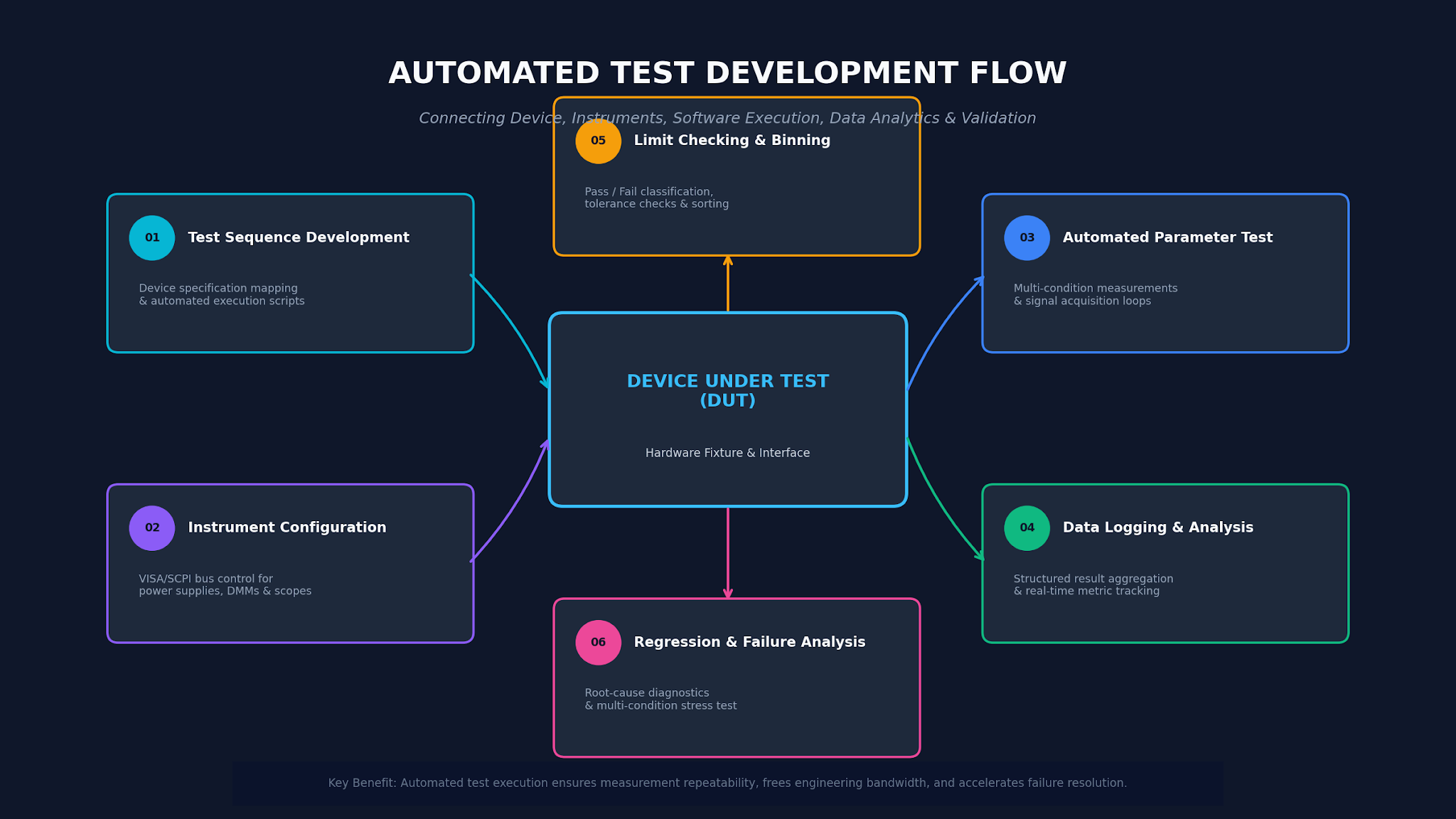
A typical automated flow can include:
- Test sequence development based on device specifications
- Instrument configuration and control
- Automated parameter measurements
- Data logging and result analysis
- Limit checking and binning
- Failure detection and reporting
- Regression testing across different device conditions
A well-designed system allows engineers to run the same sequence repeatedly without manually configuring every measurement. This improves consistency while freeing engineers to focus on analysing results and resolving failures.
Key Challenges in Automating Mixed-Signal Tests
Managing Different Measurement Requirements
Mixed-signal ICs may require voltage, current, frequency, timing, noise, gain, linearity, and other measurements. Each parameter can require different equipment and measurement methods.
The automation framework must coordinate these instruments accurately. Poor sequencing or incorrect instrument settings can produce unreliable results, even when the test program itself appears to work.
Handling Large Test Data Volumes
Automated testing can generate substantial amounts of measurement data, especially when devices are evaluated across multiple conditions. Simply collecting the data is not enough.
Test software should organize results in a way that makes trends and abnormal behavior easy to identify. Automated data analysis can help engineers detect recurring failures, compare devices, and investigate unusual measurements without manually reviewing every result.
Maintaining Test Accuracy
Automation reduces manual effort, but it does not automatically guarantee accurate results. Measurement conditions, calibration, timing, instrumentation, and test limits all need careful consideration.
Characterization should therefore be performed before production limits are finalized. Testing across process, voltage, and temperature conditions can help engineers understand normal device variation and distinguish it from genuine failures.
Best Practices for Faster Test Development
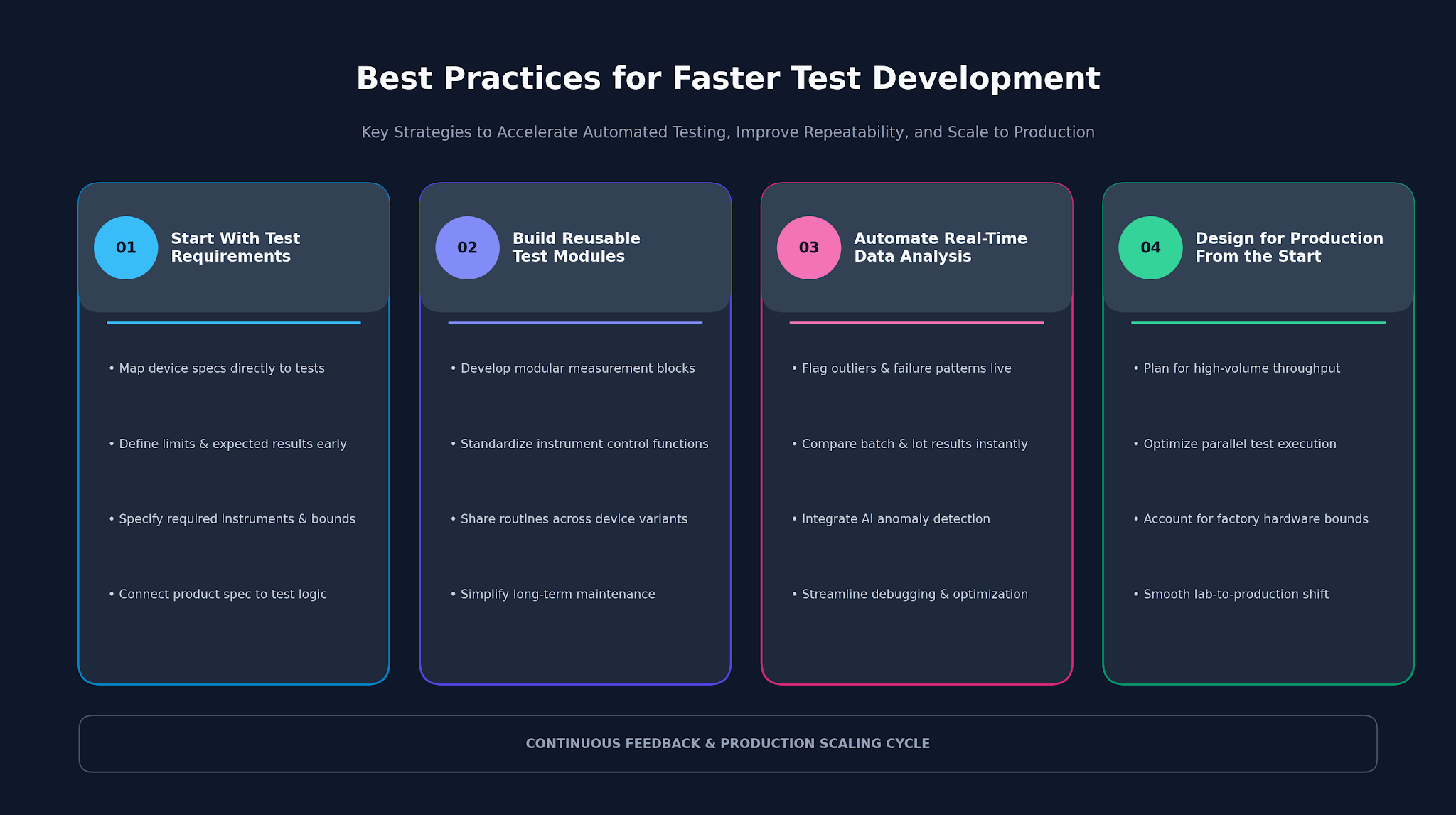
Start With Test Requirements
Before developing the automation flow, define what needs to be measured and why. Map device specifications to individual tests, required instruments, operating conditions, limits, and expected results.
This creates a clear connection between the product specification and the eventual test program.
Build Reusable Test Modules
Instead of creating every test from scratch, engineers can develop reusable modules for common measurements and instrument functions. This makes future test development faster and simplifies maintenance.
Reusable structures are particularly valuable when multiple device variants share similar architectures or test requirements.
Automate Data Analysis Alongside Testing
Data analysis should be considered part of the automation strategy rather than an activity performed after testing.
Automated analysis can flag outliers, identify recurring failure patterns, compare results across lots, and support faster debugging. Tessolve also describes AI-enabled test engineering workflows that can support test-program optimization, anomaly detection, and analysis of large-scale test data.
Design for Production From the Beginning
A test flow that works in a laboratory may not be suitable for high-volume manufacturing. Production environments require repeatability, throughput, maintainability, and efficient use of automated test equipment.
This is where test engineering services can support the transition from development to production. A structured approach considers test hardware, software, instrumentation, parallelism, platform requirements, and production constraints early in the process.
How Automation Reduces Validation Time
The biggest advantage of automation is not simply that tests run without human intervention. It is that the entire validation cycle becomes more repeatable and easier to analyze.
Automated regression testing allows engineers to rerun large test suites after design or software changes. Automated measurement reduces repetitive setup work. Centralized data collection makes results easier to compare, while automated reporting reduces the time spent preparing test summaries.
Automation can also support faster failure isolation. When test results are consistently captured, engineers can trace failures back to specific parameters, operating conditions, or device groups.
For complex products, this structured approach can make semiconductor testing more scalable from early characterization through production.
The Role of ATE in Automated Testing
Automated Test Equipment, or ATE, provides the hardware foundation for many production test environments. It can execute programmed tests, control measurements, collect results, and support high-volume device testing.
However, the effectiveness of ATE depends heavily on the test program and supporting engineering infrastructure. Platform selection, program development, hardware interfaces, test sequencing, and optimization all influence overall test performance.
Modern ATE workflows can also use parallelism and adaptive approaches to improve throughput. Tessolve’s test engineering capabilities include test program development, characterization, platform conversions, multisite testing, and test-time optimization across development and production environments.
Automated Test Equipment (ATE) Modernization: Enhancing Efficiency in Electronics Testing
Tessolve’s Approach to Automated Test Development
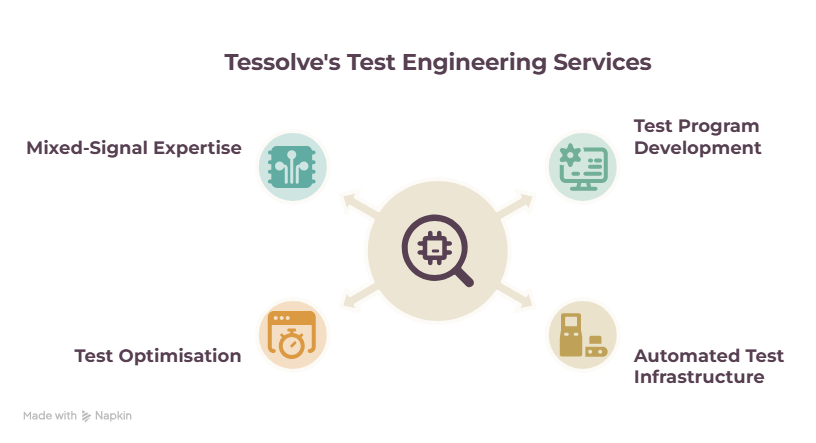
At Tessolve, we provide test engineering capabilities covering mixed-signal, analog, digital, RF, power-management, and sensor devices, supporting the transition from development to production.
- Test Program Development: We develop test programs and support device characterisation across process, voltage, and temperature conditions.
- Automated Test Infrastructure: Our capabilities include advanced ATE platforms, test hardware development, wafer sort, final test, and bench characterisation.
- Test Optimisation: We support test-time reduction, platform conversion, parallelism scaling, and yield optimisation.
- Mixed-Signal Expertise: Our test engineering experience covers analog and mixed-signal devices, along with RF, sensors, and power-management products.
Frequently Asked Questions
1. What is automated test development for mixed-signal ICs?
It uses software and equipment to automate measurements, validation, data collection, and analysis of mixed-signal devices.
2. How does automation reduce IC validation time?
Automation reduces repetitive manual tasks, speeds measurements, improves consistency, and enables faster analysis of test results.
3. What challenges arise when testing mixed-signal ICs?
Engineers must evaluate analog and digital functions while managing signal integrity, electrical variations, timing, and measurement accuracy.
4. Why is automated data analysis important for IC testing?
Automated analysis helps identify failures, detect trends, compare results, and reduce time spent manually reviewing large datasets.
5. How does ATE support mixed-signal semiconductor testing?
ATE automates measurements, executes test programs, collects results, and supports repeatable testing across development and production environments.