
The automotive industry is rapidly evolving as vehicles transform into intelligent, software-defined machines powered by advanced electronics. Technologies such as Electric Vehicles (EVs), Advanced Driver Assistance Systems (ADAS), autonomous driving, and connected platforms are increasing the demand for high-performance computing within vehicles.
These innovations rely on advanced chip design capable of handling complex workloads while maintaining reliability and energy efficiency. To achieve this, automakers often collaborate with an experienced ASIC design company or a specialized chip design company to develop efficient chip solutions.
Two major semiconductor technologies used in automotive systems are ASIC (Application-Specific Integrated Circuit) and FPGA (Field-Programmable Gate Array). Each offers different advantages in performance, flexibility, and cost. Understanding their differences helps engineers choose the right architecture for EV and ADAS platforms.
Why Specialized Chips Are Critical in Modern Vehicles
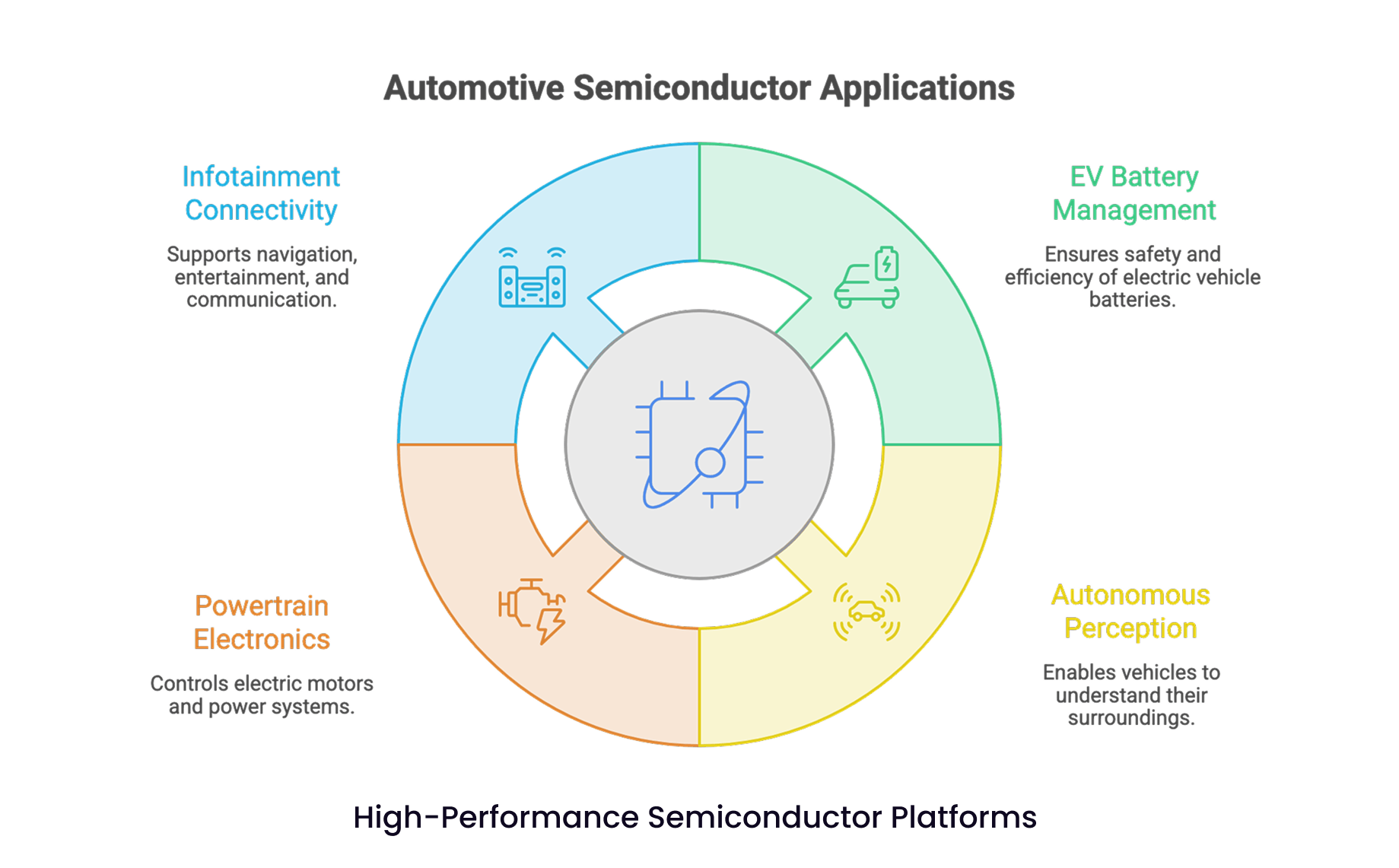
Modern vehicles rely on numerous electronic systems that process large volumes of data in real time. This growing complexity makes specialized semiconductor platforms essential for automotive innovation. Advanced chip design enables vehicles to process sensor data, manage power systems, and support intelligent driving features.
Key automotive systems that depend on high-performance semiconductor platforms include:
- Autonomous perception systems – Process data from cameras, radar, LiDAR, and ultrasonic sensors to understand the vehicle’s surroundings.
- Battery management systems in EVs – Monitor battery temperature, charge levels, and performance to ensure safety and efficiency.
- Powertrain electronics – Control electric motors, inverters, and vehicle power systems.
- Infotainment and connectivity platforms – Support navigation, entertainment, and communication features.
Key Automotive Requirements for Semiconductor Platforms
Automotive semiconductor platforms must meet strict performance, safety, and reliability requirements.
- Functional safety: Compliance with standards such as ISO 26262 to ensure safe operation.
- Low latency: Real-time processing for ADAS and autonomous driving decisions.
- High reliability: Stable performance throughout the long vehicle lifecycle.
- Energy efficiency: Essential for EV platforms to maximize battery range.
ASIC vs FPGA: Key Differences for Automotive Applications
Choosing between ASIC and FPGA architectures requires careful evaluation of several factors. Each technology offers advantages depending on the application, production scale, and development stage.
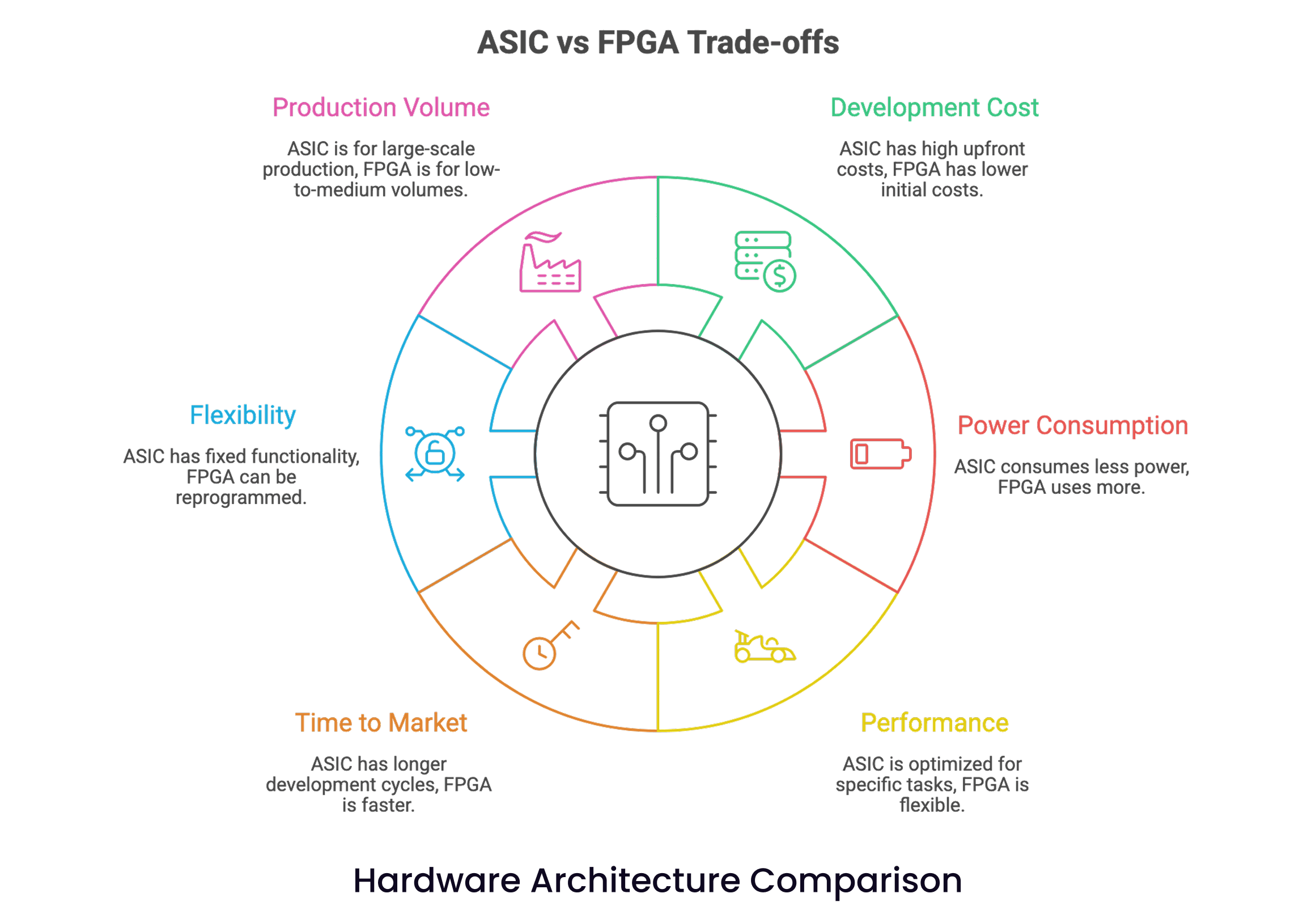
Summary Comparison Table
|
Factor |
ASIC |
FPGA |
|
Performance |
Highly optimized for specific tasks, delivering maximum performance. |
Flexible but generally less optimized due to programmable logic overhead. |
|
Power Consumption |
Consumes significantly less power because of dedicated architecture. |
Higher power usage due to reconfigurable hardware. |
|
Development Cost |
Requires a large upfront investment, often handled by an experienced ASIC design company. |
Lower initial cost, making it suitable for development and experimentation. |
|
Time to Market |
Longer development cycles due to complex chip design and fabrication processes. |
Faster development and deployment. |
|
Flexibility |
Fixed functionality once fabricated. |
Hardware can be reprogrammed and updated when requirements change. |
|
Production Volume |
Best suited for large-scale vehicle production. |
Ideal for low-to-medium volumes or early-stage product development. |
For automotive manufacturers developing EV and ADAS platforms, the choice between these technologies often depends on the development stage and long-term product goals. Working with an experienced chip design company can help organizations build the most suitable chip solutions for modern automotive systems.
Role of ASICs in EV and ADAS Platforms
ASICs play an important role in EV and ADAS systems because they deliver high performance and energy efficiency for dedicated automotive functions. Through advanced chip design, engineers create optimized silicon tailored to specific vehicle applications. Many automakers partner with an experienced ASIC design company or chip design company to develop reliable chip solutions for large-scale production.
1. EV Powertrain and Battery Management Systems
Electric vehicles require precise monitoring and control of power systems. ASICs are commonly used because they provide reliable performance with low power consumption. Dedicated ASIC chips support:
- Battery monitoring to track voltage, temperature, and charge cycles
- Motor control for managing electric motor performance
- Energy management to optimize power distribution
Custom chip design ensures stable and efficient EV operation.
2. ADAS Sensor Processing
ADAS platforms depend on the fast processing of sensor data. ASIC chips efficiently handle tasks such as:
- Radar signal processing
- Camera pipeline processing
- LiDAR data processing
These optimized chip solutions help ADAS systems operate with low latency.
3. Automotive AI Accelerators
ASIC-based accelerators are also used for automotive AI workloads, including:
- Object detection
- Lane detection
- Driver monitoring systems
Working with an experienced ASIC design company helps automakers build efficient AI-powered ADAS systems.
Role of FPGAs in EV and ADAS Development
While ASICs are commonly used in production vehicles, FPGAs play an important role during development and testing. Their programmable nature allows engineers to experiment with architectures before final silicon is manufactured. Because of this flexibility, FPGAs are widely used in advanced chip design projects and evolving chip solutions.
1. Prototyping Autonomous Driving Algorithms
Autonomous driving depends on complex perception and control algorithms. Engineers often use FPGA platforms to prototype and validate these algorithms before production hardware is finalized.
2. Sensor Fusion and Data Processing
ADAS systems combine data from multiple sensors simultaneously. FPGA architectures support this through parallel processing and flexible configuration. Common sensor inputs include cameras, radar, LiDAR, and ultrasonic sensors. A skilled chip design company can use FPGA platforms to validate sensor fusion architectures.
3. Over-the-Air Hardware Updates
A key advantage of FPGAs is reprogrammability. Engineers can update hardware functionality when standards or algorithms evolve, without redesigning the entire system.
4. ADAS Development Platforms
FPGAs are widely used in ADAS development for testing and validation. Engineers can refine architectures and verify system performance before transitioning to ASIC-based production hardware.
When Should Automotive Companies Choose ASIC or FPGA?
Automotive companies choose between ASIC and FPGA technologies based on development stage, production scale, and system requirements. Both architectures support advanced chip design, but their advantages differ depending on the application.
When to Choose ASIC
ASICs are typically preferred when systems move into large-scale vehicle production. Their optimized architecture delivers higher performance, lower power consumption, and reduced cost per unit. Automakers often collaborate with an experienced ASIC design company or chip design company to develop efficient chip solutions for production vehicles.
ASICs are ideal for:
- High-volume vehicle manufacturing
- Mature algorithms and stable system requirements
- Ultra-low power consumption, especially in EV platforms
- Performance-critical automotive systems
- Long product lifecycle platforms
Common ASIC use cases include ADAS processors, EV motor control chips, and battery management ICs.
When to Choose FPGA
FPGAs are better suited for early development and experimentation because of their programmable architecture. Engineers frequently use FPGA platforms while working with a chip design company to prototype and test new chip solutions.
FPGAs are useful for:
- Early product development and evolving architectures
- Rapid prototyping of automotive technologies
- Changing algorithms or standards
- Low production volumes
- Hardware research and experimentation
Typical FPGA applications include autonomous vehicle R&D, sensor interface development, and AI model validation.
Hybrid Approach: Using FPGA and ASIC Together
Many modern automotive platforms adopt a hybrid approach that combines both FPGA and ASIC technologies. This strategy allows companies to take advantage of FPGA flexibility during development while leveraging ASIC efficiency for final production systems. In a typical workflow, FPGA platforms are used for prototyping, testing, and validating system architectures, algorithms, and hardware functionality. Once the design becomes stable and ready for large-scale deployment, it is implemented as an ASIC to achieve better performance, lower power consumption, and reduced unit cost.
This approach helps accelerate innovation, reduce development risks through extensive testing, and improve production efficiency. A common example is using an FPGA prototype before transitioning to ASIC production silicon or integrating FPGA accelerators with ASIC processors. By working with an experienced ASIC design company, automakers can develop balanced chip solutions that optimize performance, flexibility, and cost.
Accelerate Your Automotive Silicon Innovation with Tessolve
Tessolve helps automotive companies transform complex silicon ideas into production-ready solutions. With deep expertise in ASIC design, FPGA prototyping, VLSI engineering, and post-silicon validation, our teams support the entire semiconductor lifecycle, from concept and architecture to packaged silicon and production ramp-up.
Our engineers specialize in building high-performance chip solutions for demanding applications such as EV power electronics, ADAS processing, sensor interfaces, and automotive AI accelerators. By combining strong pre-silicon design capabilities with advanced testing and validation infrastructure, we help organizations reduce development risk and accelerate time-to-market.
If you are developing next-generation EV or ADAS platforms, Tessolve can help you design scalable, efficient silicon architectures that power the future of intelligent vehicles.
Frequently Asked Questions
1. What is the main difference between ASIC and FPGA in automotive systems?
ASICs are custom-designed chips optimized for specific functions, while FPGAs are programmable devices that allow engineers to modify hardware logic after deployment.
2. Why are ASIC chips commonly used in production vehicles?
ASIC chips provide higher performance, lower power consumption, and reduced cost per unit, making them ideal for large-scale automotive manufacturing.
3. How do FPGAs help during EV and ADAS development?
FPGAs enable rapid prototyping and testing of algorithms, allowing engineers to validate architectures and system performance before finalizing production silicon designs.
4. Can FPGA-based systems be upgraded after deployment?
Yes, FPGAs can be reprogrammed, allowing engineers to update algorithms, improve performance, or adapt to new standards without changing hardware.
5. What automotive systems typically use ASIC technology?
ASICs are commonly used in ADAS processors, EV motor controllers, battery management systems, radar processing units, and automotive AI accelerators.
6. Why do automotive companies sometimes use both FPGA and ASIC together?
Companies use FPGAs for development and testing, then transition to ASICs for mass production to achieve better efficiency, performance, and cost optimization.