
Key Semiconductor Industry Trends: All You Need to Know in 2026
The semiconductor industry continues to evolve rapidly, driven by AI, High-Performance Computing (HPC), automotive electronics, cloud infrastructure, and edge AI applications. While earlier discussions focused on supply chain recovery and pandemic-related disruptions, the industry’s attention has now shifted toward advanced process nodes, chiplet architectures, heterogeneous integration, advanced packaging, and sustainable semiconductor manufacturing.
Modern semiconductor innovation is no longer driven solely by transistor scaling. AI accelerators, High-Bandwidth Memory (HBM), advanced packaging technologies, and next-generation process nodes are redefining chip design, manufacturing, and testing across the industry. Leading providers of semiconductor services are helping businesses adopt these technologies faster while delivering scalable solutions for emerging applications. Here are some of the most important semiconductor trends shaping today’s market.
Trend 1: Advanced Process Nodes Continue to Push Performance
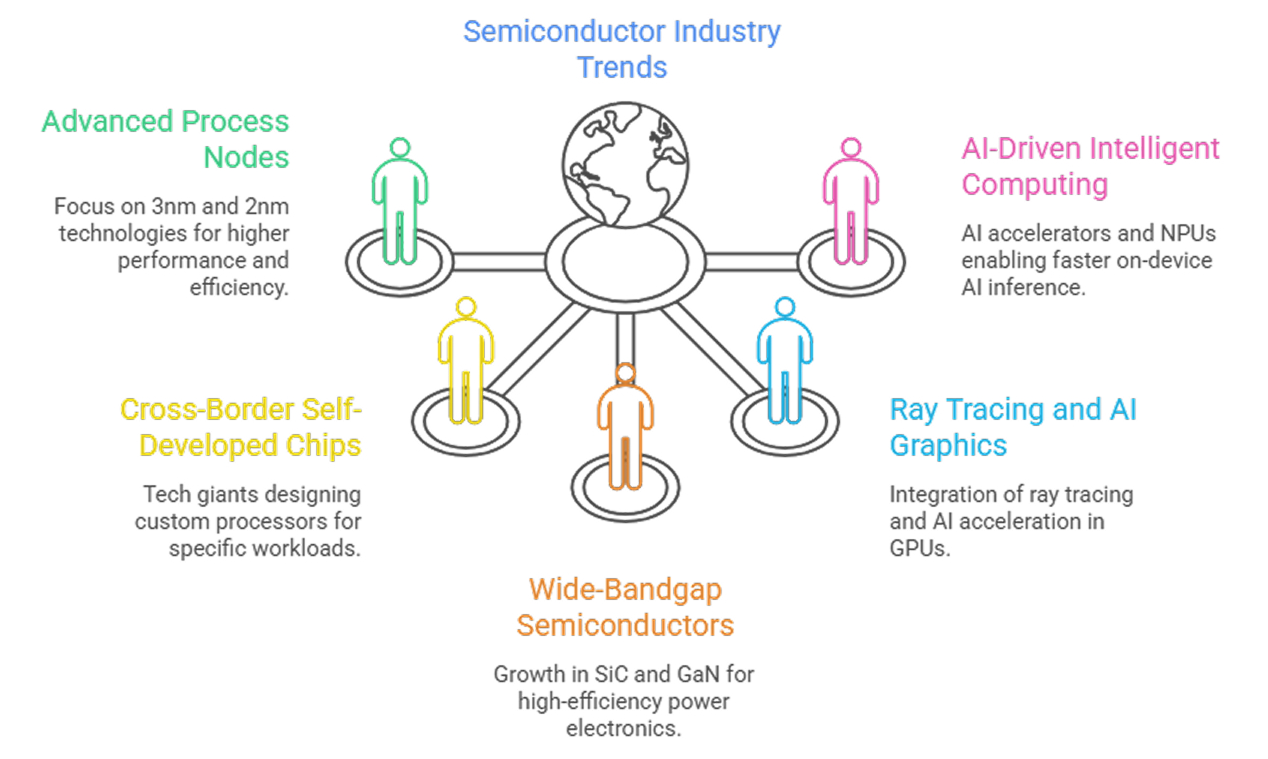
Although the complexity and cost of advanced process nodes such as 3nm and emerging 2nm technologies have risen drastically, they remain essential for manufacturers pursuing higher performance and lower power consumption. Modern transistor architectures such as Gate-All-Around (GAA) nanosheet transistors, advanced packaging, and chiplet integration are helping overcome scaling limitations while improving performance, efficiency, and silicon density.
Trend 2: The Trend of Cross-Border Self-Developed Chips Will Be More Obvious
Nowadays, standard chips no longer meet the requirements of the world’s top tech giants such as Amazon, Apple, Facebook, and Tesla. Instead of relying solely on merchant semiconductor vendors, organizations are increasingly developing custom AI, cloud, automotive, and edge computing processors optimized for their own workloads.
One of the significant advantages of building an in-house chip design team is greater control over product roadmaps, supply chains, and performance optimization. This trend has also accelerated partnerships between semiconductor design companies, foundries, and advanced packaging providers to shorten development cycles. Businesses often collaborate with a top semiconductor company to access specialized design expertise and accelerate product development.
Trend 3: Wide-Bandgap Semiconductors Continue to Gain Momentum
Silicon Carbide (SiC) and Gallium Nitride (GaN) have become critical technologies for high-efficiency power electronics. Growing adoption in electric vehicles, renewable energy systems, industrial automation, AI infrastructure, and fast-charging applications continues to drive investment in larger wafer production and manufacturing capacity.
Manufacturers are expanding 8-inch SiC wafer production while improving manufacturing yields to meet the increasing demand for next-generation power devices.
Trend 4: Ray Tracing and AI Graphics Continue to Transform GPUs
Real-time ray tracing has become a standard feature across modern GPUs, delivering realistic lighting, shadows, and reflections in gaming and professional visualization. Today’s graphics processors also integrate dedicated AI acceleration technologies for image upscaling, content generation, and rendering optimization alongside ray tracing capabilities.
These innovations are now widely adopted across gaming, AI workstations, cloud graphics, and high-performance computing platforms. This creates new opportunities for advanced semiconductor solutions across multiple industries.
Trend 5: AI is Driving the Next Generation of Intelligent Computing
AI continues to transform computational photography, machine vision, and intelligent automation. Dedicated AI accelerators and Neural Processing Units (NPUs) are now integrated into smartphones, automotive systems, industrial equipment, edge devices, and data center processors, enabling faster on-device AI inference while improving power efficiency.
Organizations increasingly depend on expert semiconductor services to support AI chip development, validation, packaging, and production as these intelligent computing platforms become more sophisticated.
Conclusion
The semiconductor industry continues to evolve rapidly, driven by AI, high-performance computing, electric vehicles, advanced packaging, chiplet architectures, and next-generation semiconductor technologies. As businesses accelerate investments in cloud infrastructure, AI, and connected devices, demand for innovative semiconductor solutions continues to grow.
At Tessolve, a top semiconductor company, we help customers accelerate semiconductor innovation through end-to-end silicon engineering, covering chip design, advanced packaging, embedded systems, test engineering, and product realization. With expertise spanning pre-silicon to post-silicon validation, Tessolve enables organizations to develop reliable, high-performance semiconductor solutions for next-generation applications. Our expertise in VLSI designs further supports the development of complex, high-performance chips for AI, automotive, industrial, and next-generation computing applications.
Frequently Asked Questions
1. What are the biggest trends shaping the semiconductor industry today?
AI, advanced packaging, chiplet architectures, wide-bandgap semiconductors, and advanced process nodes are driving industry innovation.
2. Why are chiplet architectures becoming increasingly popular?
Chiplets improve scalability, reduce manufacturing costs, enhance performance, and simplify the development of complex semiconductor devices.
3. How is AI influencing semiconductor development?
AI accelerates chip design, enables intelligent computing, improves verification, and enhances performance across multiple semiconductor applications.
4. Why are Silicon Carbide and Gallium Nitride important?
SiC and GaN enable higher efficiency, faster switching, and better thermal performance in power electronics applications.
5. How can Tessolve support semiconductor product development?
Tessolve provides end-to-end semiconductor engineering, from VLSI design and verification to testing, packaging, and product realization.