The aviation industry has always been at the forefront of technological innovation, constantly pushing boundaries to enhance safety, efficiency, and passenger experience. As 5G connectivity becomes increasingly available across airports and aviation environments, aviation is poised for further transformation. Implementing 5G technology promises faster connectivity, more connected airport operations, and data-driven services for airlines, airports, and passengers.
In this blog post, we explore how 5G will transform the aviation industry and highlight Tessolve’s pioneering efforts in PCB hardware design solutions for 5G.
Understanding the Potential of 5G in Aviation
- Enhanced Connectivity: 5G is not just an incremental improvement over 4G; it’s a game-changer. With faster data speeds, lower latency, and higher device density, 5G will enable high-speed connectivity across airports and compatible aviation environments. Passengers will enjoy ultra-fast internet access, high-definition streaming, and real-time communication, making long flights more enjoyable and productive.
- Improved Safety: Safety is paramount in aviation, and 5G can support safety-related operations indirectly by improving connectivity between ground teams, connected equipment, maintenance systems, and operational platforms. The ability to transmit data with lower latency can support faster information exchange, remote monitoring, predictive maintenance, and improved situational awareness, helping aviation organisations respond more efficiently to operational issues.
- Efficient Operations: Airlines will benefit from 5G’s capabilities in optimizing flight operations. Ground crews can use augmented reality (AR) and virtual reality (VR) for maintenance and training, reducing downtime and improving efficiency. 5G-enabled IoT devices can also support connected baggage handling, equipment monitoring, asset tracking, and other airport processes, helping improve operational visibility and resource utilization
- Autonomous Aircraft: The aviation industry is actively exploring increasingly automated aircraft and flight operations. However, autonomous aviation depends on much more than 5G connectivity. It requires advanced sensing, navigation, onboard computing, redundant control systems, cybersecurity, and rigorous safety certification. 5G may support selected communications and ground-operation use cases, but it should be considered an enabling connectivity technology rather than the sole technology behind autonomous aircraft.
- Remote Air Traffic Control: Remote and digital air traffic management technologies are already being explored and deployed in selected aviation environments. 5G can complement these systems by providing reliable connectivity for cameras, sensors, communications equipment, and other connected infrastructure. However, remote air traffic control depends on specialized communication networks, redundancy, cybersecurity, regulatory approval, and safety-critical systems rather than 5G alone.
Tessolve’s Role in 5G Testing and PCB Hardware Design
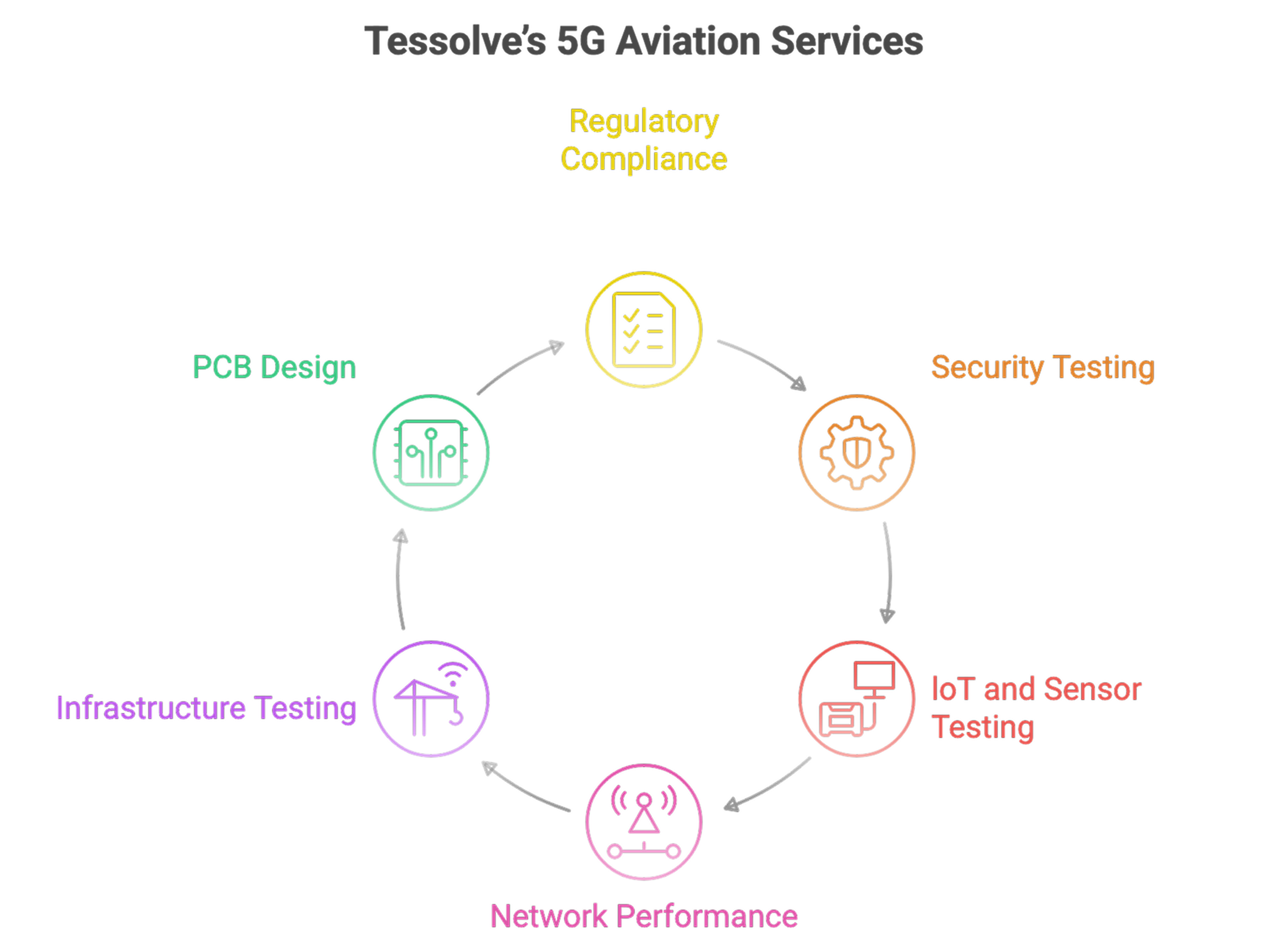
Tessolve, a technology company specialising in semiconductor engineering and testing services, brings extensive expertise in PCB design, high-speed hardware, RF and mixed-signal systems, simulation, and hardware validation. These capabilities are relevant to the electronic infrastructure supporting next-generation connectivity applications, including 5G.
- PCB Hardware Design Solutions: Tessolve provides turnkey PCB design and manufacturing support spanning schematic design, layout, simulation, mechanical engineering, DFM validation, fabrication, and assembly. Its experience across high-speed digital, RF, mixed-signal, HDI, and high-power boards supports demanding hardware requirements.
- Infrastructure Testing: Tessolve’s state-of-the-art testing facilities are equipped to validate the performance and reliability of 5G infrastructure components, including PCBs. They ensure that the hardware meets the stringent requirements of the aviation industry.
- Network Performance: Tessolve conducts extensive network performance testing to assess the speed, coverage, and reliability of 5G networks in aviation environments. This is crucial for ensuring seamless connectivity and communication during flights.
- IoT and Sensor Testing: With the proliferation of IoT devices and sensors in aviation, Tessolve plays a critical role in testing and validating these devices for compatibility with 5G networks and PCB hardware. This ensures that data from sensors, such as engine health monitors and weather sensors, can be transmitted reliably and in real time.
- Security Testing: Security is a top priority in aviation. Tessolve conducts rigorous security testing to identify vulnerabilities in 5G networks, PCB hardware, and connected devices, helping to safeguard against cyber threats that could compromise safety and data integrity.
- Regulatory Compliance: Tessolve ensures that all 5G implementations in aviation adhere to regulatory standards, including those related to PCB hardware design and performance.
Future of Aviation with 5G and Tessolve’s PCB Hardware Solutions
As 5G technology continues to mature and expand its presence in the aviation industry, we can expect several transformative developments in the coming years:
- Connected Flights: Passengers will have access to high-speed internet throughout their journey where suitable connectivity infrastructure is available, supported by increasingly advanced wireless and onboard electronic systems.
- Smart Airports: Airports will become smarter and more efficient, with 5G-enabled PCB hardware providing advanced baggage tracking, biometric security checks, and efficient passenger flow management.
- Predictive Maintenance: Airlines can combine 5G connectivity with IoT sensors and analytics to support predictive maintenance, while reliable PCB hardware remains essential for connected monitoring systems.
- Autonomous Aircraft : Advanced automation will continue to influence aircraft and airport operations. 5G can support selected connected systems, but autonomous aircraft will require a broader combination of sensing, computing, navigation, control, cybersecurity, redundancy, and safety-certified technologies.
- Environmental Impact: 5G-enabled technologies can help optimize flight paths and reduce fuel consumption, contributing to a more sustainable aviation industry, with Tessolve’s PCB design solutions playing a role in these innovations.
5G IoT & How It Is Significant for the Future of Connected Vehicles
Final Thought
The aviation industry has always embraced technological advancements to enhance operations and improve passenger experience. 5G is becoming an important connectivity layer for this transformation, supporting applications ranging from passenger connectivity and airport IoT to connected maintenance and data-driven operations. However, aviation requires technologies that meet demanding standards for reliability, cybersecurity, redundancy, and safety.
Tessolve’s expertise in PCB hardware design, high-speed electronics, RF and mixed-signal engineering, simulation, testing, and validation can support the development of reliable electronic systems for next-generation connectivity applications. As aviation becomes increasingly connected and digital, robust hardware engineering will remain essential to turning these technological possibilities into practical solutions.
Frequently Asked Questions
1. What is 5G in aviation, and how can it transform the industry?
5G in aviation can improve connectivity, airport operations, IoT applications, maintenance, passenger services, and data-driven aviation systems.
2. How is the 5G aerospace market evolving?
The 5G aerospace market is evolving through connected aircraft, airport IoT, high-speed communication, predictive maintenance, and advanced aviation technologies.
3. What is the 5G market in aviation expected to support?
The 5G market in aviation can support smart airports, connected operations, passenger connectivity, IoT devices, and data-intensive applications.
4. What is 5G luchtvaart, and why is it important?
5G luchtvaart refers to 5G applications in aviation, supporting faster connectivity, connected operations, IoT, maintenance, and passenger experiences.
5. What are the key benefits of 5G technology for the aviation industry?
Key benefits include faster connectivity, lower latency, greater device capacity, improved operational efficiency, and enhanced connected aviation services.