Industrial IoT is rapidly moving past basic, old-school automation. For years, factories relied on rigid rules, cloud-based dashboards, and pre-programmed responses to track machinery and handle plant operations. While that setup worked fine for routine tasks, it completely choked whenever unpredictable situations popped up or when a machine needed to make an adaptive decision on the fly. Today, industrial operators want something much smarter, systems that can read a room, understand context, and troubleshoot problems more like an experienced human operator. This is exactly where Vision-Language-Action (VLA) models are changing the game.
By tying together visual recognition, natural language processing, and real-time decision-making, VLA models allow machinery to interpret complex, messy industrial scenarios. Thanks to recent leaps in chip architecture, companies are aggressively pushing for VLA model edge deployment industrial IoT solutions, bringing this advanced AI reasoning straight to local devices on the factory floor.
Why Industrial IoT Needs Human-Like Reasoning
Industrial environments are naturally chaotic, dirty, and unpredictable. Standard automation setups thrive when everything goes exactly as planned, but they struggle the second a wrench gets thrown into the gears.
Picture a high-speed manufacturing line where a robotic arm suddenly hits a slight mechanical stutter, a nearby sensor registers a temperature spike, and an overhead camera spots a tiny cosmetic defect on the product all at once. A traditional, rule-based system would likely flag these as three completely separate, minor alerts. A VLA model, however, can stitch those clues together, read between the lines, and instantly decide if the whole line needs to pause to prevent a major breakdown.
This capability for human-like reasoning edge AI sensor fusion is quickly becoming an absolute necessity for industrial plants aiming to eliminate unexpected downtime, protect workers, and optimize daily throughput.
Factories are currently drowning in data from cameras, LiDAR, microphones, and traditional controllers. The real battle is no longer about gathering that data; it is about making sense of it instantly.
Moving Intelligence from Cloud to Edge
For a long time, industrial AI lived entirely in the cloud. Local devices gathered data and shipped it off to massive remote servers for processing. While that architecture works fine for basic predictive maintenance reports, it introduces massive latency, eats up bandwidth, exposes data security risks, and fails completely if the internet drops.
In a fast-paced industrial setting, an automated system often needs to make a life-or-death decision in milliseconds. Waiting for a cloud server to respond simply isn’t an option when connectivity is spotty or when real-time precision is mandatory.
This critical bottleneck is driving a massive wave of edge AI development. Modern silicon and neural accelerators can now crunch heavy AI workloads right inside the machine itself. Because of this, engineering teams are shifting their focus toward on-device AI reasoning embedded in industrial systems that run completely independent of a cloud connection.
Processing VLA models locally brings a massive set of perks:
- Near-instantaneous decision making and reaction times
- Zero reliance on external network connections
- Keeps proprietary operational data safely inside the facility
- Drastically cuts down on local network bandwidth costs
- Ensures reliable operations in remote oil fields or mining sites
This structural shift is transforming factories from reactive environments into truly self-thinking, autonomous ecosystems.
Power-Efficient Chip Design for the IoT Era
TinyML vs VLA Models: What’s the Difference?
Many smart factories already use TinyML to handle simple predictive maintenance or basic acoustic monitoring. These models are tiny, highly optimized for low-power microcontrollers, and do a fantastic job at narrow, single-focus tasks.
However, as operational demands grow, a fascinating TinyML vs VLA model for IIoT comparison is starting to emerge among developers.
While TinyML is incredibly efficient, it usually only monitors one specific variable, like detecting an abnormal vibration frequency on a conveyor belt. VLA models operate on a whole different level. They blend multiple data streams, understand complex cause-and-effect relationships, interpret text instructions from human workers, and generate smart, adaptive actions on the fly.
To put it simply in an industrial setting:
- TinyML can tell you that a machine is breaking down.
- A VLA model understands why it’s breaking down, explains the issue, and decides exactly how to fix it.
Of course, running a VLA model requires exponentially more computational horsepower, which puts the spotlight squarely on hardware optimization.
The Role of Embedded Hardware in Real-Time AI
Deploying heavy AI models out in the field is no walk in the park. Industrial hardware has to survive extreme temperatures, constant vibrations, power limits, and 24/7 runtimes. This is where specialized hardware design becomes a make-or-break factor.
Next-generation industrial gear now comes equipped with powerful GPUs, NPUs, and specialized AI accelerators tailored specifically for real-time AI inference industrial embedded hardware applications.
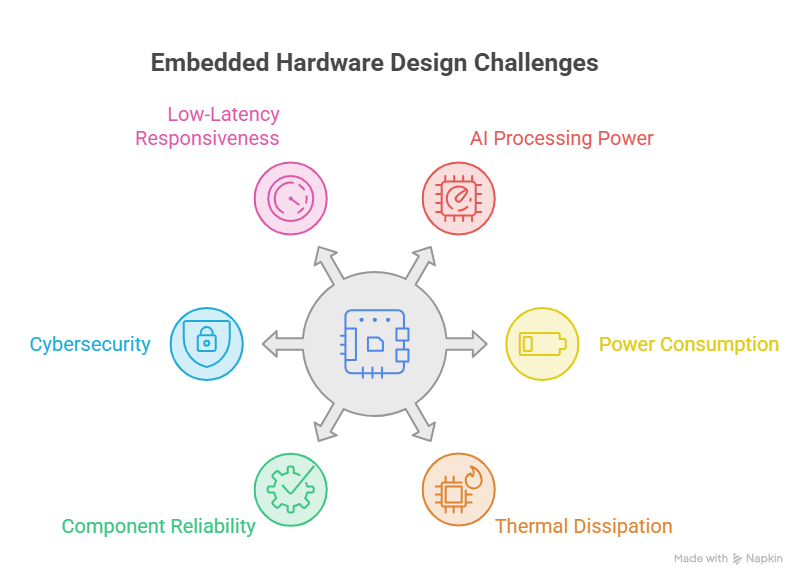
When building these systems, developers have to balance a tightrope of conflicting needs:
- Raw AI processing muscle
- Strict power consumption ceilings
- Passive thermal dissipation and cooling
- Long-term component reliability
- Hardware-level cybersecurity
- Deterministic, low-latency responsiveness
Balancing these factors has triggered a huge surge in advanced embedded computing design methodologies capable of hosting massive AI models without causing system instability. On top of that, smart software optimization, like tight memory management and low-latency inference pipelines, is equally crucial to making edge deployment a reality.
Challenges of Deploying VLA Models at the Edge
While the potential is massive, getting VLA models to run reliably on a chaotic factory floor is incredibly tough. Here is what engineering teams are up against:
- Massive Model Size: These models are computationally heavy. Shrinking them down for tight edge hardware requires complex software tricks like quantization and pruning without destroying their core reasoning skills.
- Zero Room for Error: Industrial systems demand absolute precision. You cannot risk an AI model hallucinating or acting unpredictably when managing heavy, dangerous machinery.
- Cybersecurity Risks: Giving edge devices autonomous power makes them high-value targets. Securing local software loops against tampering is critical for physical safety.
- Legacy Machinery: Most factories are a patchwork of old hardware. Making cutting-edge AI talk smoothly to a 20-year-old PLC requires specialized embedded system development expertise to bridge the gap.
How Tessolve Helps Accelerate Edge AI Innovation
At Tessolve, we know the future of Industrial IoT belongs to smart edge systems that can think, reason, and react on their own in real time. Our engineering teams specialize in high-end embedded software development services that help industrial companies bridge the gap between complex AI research and rugged, production-ready hardware.
From designing AI-accelerated edge platforms to handling multi-sensor integration and safety-critical validation, we help organizations build reliable hardware architectures optimized for modern workloads. Our expertise spans semiconductor engineering, embedded product design, custom software optimization, and rigorous industrial testing.
As VLA models continue to redefine what is possible on the factory floor, Tessolve gives you the technical foundation to build smarter, safer, and highly adaptive edge systems with total confidence.
Frequently Asked Questions
1. What makes VLA models different from traditional industrial AI systems?
VLA models combine vision, language, and actions together, helping machines understand situations instead of following fixed instructions only.
2. Why are industries shifting AI processing from cloud to edge devices?
Edge AI reduces delays, improves reliability, and allows faster decision-making even when internet connectivity becomes unstable or limited.
3. Can VLA models work alongside existing industrial automation systems?
Yes, VLA models can integrate with existing sensors, machines, and industrial platforms without completely replacing current infrastructure.
4. Are VLA models better than TinyML for Industrial IoT applications?
TinyML handles smaller tasks efficiently, while VLA models manage complex reasoning, contextual understanding, and adaptive industrial decision-making.
5. What industries can benefit most from edge-based VLA deployments?
Manufacturing, automotive, logistics, energy, and smart factories can greatly benefit from intelligent real-time industrial AI reasoning systems.