
System-level testing is the final frontier where semiconductor devices and embedded systems prove their readiness for the real world. Unlike block-level or functional testing, system-level validation verifies how a device behaves under realistic operating conditions, including workload stresses, environmental factors, and hardware-software interactions. For industries like automotive, IoT, consumer electronics, industrial automation, AI accelerators, and edge computing systems, this stage ensures that end products perform reliably, safely, and efficiently.
This blog explores effective system-level testing techniques and why they are critical for ensuring product success.
Why System-Level Testing Matters
System-level testing goes beyond verifying functionality; it validates end-to-end product readiness. Its importance can be understood through the following points:
- Reliability: Ensures devices can withstand long-term operation and environmental challenges.
- Integration: Verifies seamless hardware-software interaction across subsystems.
- Performance: Confirms efficiency under typical and peak workloads.
- Safety: Identifies failure modes and validates recovery mechanisms.
- Compliance: Supports certification and regulatory approvals.
- Market readiness: Reduces field failures and accelerates time-to-market.
- Cybersecurity validation: Ensures embedded systems can resist firmware vulnerabilities, unauthorized access, and communication-level attacks.
By addressing these factors, organizations minimize risk and deliver robust, customer-ready solutions that succeed in demanding real-world environments.
System Level Testing – The Differentiator
Key System-Level Testing Techniques
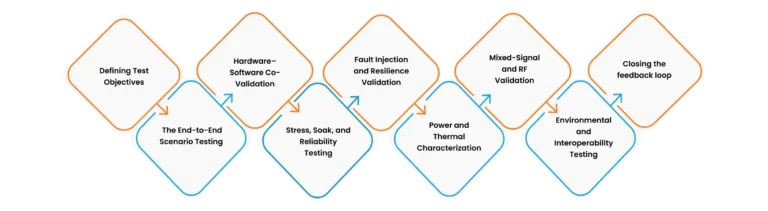
1. Defining Test Objectives
Every testing cycle must begin with clear objectives. At the system level, goals typically include:
- Functional correctness across all operating modes
- Performance validation under typical and extreme workloads
- Power and thermal behavior within design limits
- Failure mode analysis and fault recovery
- Security and interoperability validation across connected ecosystems
Setting objectives early on offers a credible pathway for planning, coverage, and resource allocation. Usually, organizations rely on test engineering specialists to define meaningful test vectors and to outline acceptance criteria that closely resemble real-world use cases.
2. The End-to-End Scenario Testing
System-level testing should accurately simulate real-life scenarios. For embedded systems, this includes processes such as booting, updating firmware, and recovering from errors. Workloads for semiconductor devices are executed alongside board-level integrations, aiming to identify bottlenecks or hidden failures.
Modern semiconductor platforms additionally require validation of OTA (Over-the-Air) updates, AI workload execution, low-power operating states, and real-time communication interfaces.
A critical role of semiconductor test engineers is to translate complex user journeys into reproducible test cases. They ensure that every function, from input/output operations to data integrity checks, is thoroughly tested.
3. Hardware–Software Co-Validation
Most modern failures occur not in isolated hardware or software, but in their interaction. Co-validation ensures firmware, drivers, and hardware logic work seamlessly. Early iterations may use emulation, but final validation requires silicon-in-the-loop environments where timing and analog effects come into play.
Today, the co-validation of hardware and software increasingly relies on virtual platforms, FPGA prototyping, and digital twins to accelerate both pre-silicon and post-silicon validation cycles. In this context, test engineering teams play a crucial role in connecting design and software groups. They help reduce integration errors and quickly identify regressions by using automated test harnesses.
4. Stress, Soak, and Reliability Testing
Reliability testing goes beyond functionality. Stress tests push devices beyond nominal limits, while soak tests expose them to extended runtime workloads. These methods uncover early wear-out mechanisms and potential design weaknesses.
Highly accelerated stress testing (HAST), thermal cycling, and voltage overstress testing are now commonly used for advanced semiconductor reliability validation.
An experienced semiconductor test engineer typically defines stress thresholds, monitors degradation, and collaborates with design teams to suggest improvements. By combining stress data with reliability modeling, organizations minimize costly field failures.
5. Fault Injection and Resilience Validation
The failure of a system brings about certain phenomena. Fault injection, the conscious induction of errors, e.g., voltage drops, communication timeouts, and corrupted data, assists in validating that the system in question reacts accordingly. This gives one confidence in the proper functioning of watchdogs, error handlers, and safety precautions. Engaging professional engineering testing services ensures fault injection is done with sufficient depth to extract the pertinent information onto recovery paths and safe-state transitions.
6. Power and Thermal Characterization
System-level testing must verify real-world power behavior across all states, including active, idle, and sleep. Power-domain transitions, current leakage, and efficiency of dynamic power management are analyzed. Thermal testing enhances cooling solution certification and hotspot distribution under load.
Test engineering teams contribute valuable expertise on measurement accuracy and provide actionable feedback for design improvements.
7. Mixed-Signal and RF Validation
Embedded systems increasingly integrate analog and RF components. Testing at this level requires evaluating spectral purity, sensitivity, interference resistance, and wireless coexistence. Issues like digital noise coupling into analog paths often only appear in system-level contexts.
The adoption of 5G, Wi-Fi 7, automotive radar, and high-speed SerDes interfaces has greatly increased the complexity of validating RF and mixed-signal designs. To effectively develop validation protocols that uncover subtle interactions in the analog domain, a semiconductor test engineer with expertise in mixed-signal design is essential.
8. Environmental and Interoperability Testing
Beyond functional testing, products should be durable enough to withstand environmental abuse from temperature, humidity, and vibration. Interoperability testing helps validate that products behave as intended across networks, protocols, and ecosystems. Interoperability is paramount for IoT and automotive.
In the end, utilizing an engineering testing services provider will enable you to take advantage of the remaining suite of chambers, interoperability labs, and compliance test suites designed for improved system stability.
9. Closing the feedback loop
The system-level performance information will be returned to design processes to aid in further improving testability, and more specifically, in developing better reliability statistics. This is the requisite feedback loop that allows an organization to iterate on the product and its test methods.
Advanced analytics and AI-driven test data platforms now help engineering teams identify defect patterns faster and optimize future validation strategies. Overall, investing in test engineering expertise should help close the gap between assessment and design intent, shorten development cycles, and enhance overall product quality.
The Future of Test Engineering: How Automation is Changing the Game
Tessolve: Driving Innovation in System-Level Testing
System-level validation is not just a process; it is a key priority for us at Tessolve. A well-designed ASIC is the heart of a reliable product, and our expert team of semiconductor test engineers develops custom test programs tailored to each customer’s needs. This approach enhances yield, reduces debug time, simplifies compliance, and lowers overall costs.
With robust infrastructure and state-of-the-art laboratories, we provide a comprehensive suite of engineering test services, including post-silicon validation, production testing, and reliability evaluation. Our expertise also covers AI hardware testing, automotive-grade validation, high-speed interface testing, and advanced silicon bring-up services.
Tessolve empowers semiconductor and embedded companies worldwide to deliver their products more efficiently and reliably, with a future-proof design. When you choose Tessolve, you are selecting more than just a vendor; you are gaining a true partner with a vested interest in your success.
Frequently Asked Questions
1. What is system-level testing in semiconductor and embedded systems?
System-level testing validates how semiconductor devices and embedded systems perform under real-world operating conditions, ensuring reliability, functionality, and performance.
2. Why is system-level validation important for semiconductor products?
System-level validation helps identify integration issues, improve reliability, verify performance, and reduce the risk of failures before product deployment.
3. What are the key techniques used in system-level testing?
Common techniques include end-to-end scenario testing, hardware-software co-validation, stress testing, fault injection, power analysis, and environmental testing.
4. How does hardware-software co-validation improve product quality?
Co-validation ensures that hardware, firmware, drivers, and software components work together seamlessly, reducing integration issues and improving system reliability.
5. What role does system-level testing play in semiconductor reliability?
System-level testing verifies device behavior under real-world workloads, environmental conditions, and stress scenarios to ensure long-term reliability and performance.