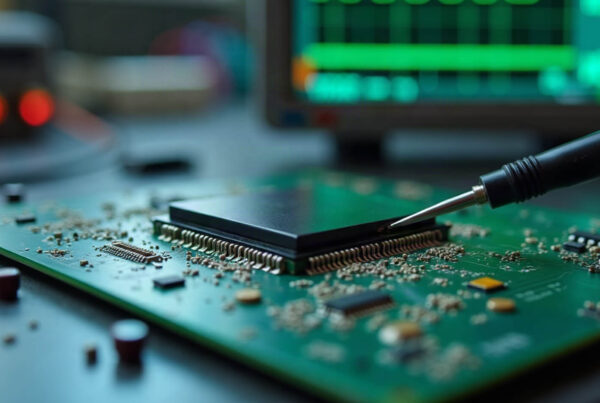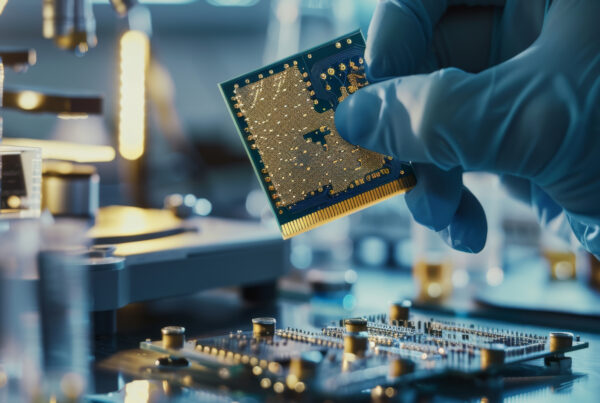

An ATE test cell brings together automated test equipment, device handling systems, probes or contactors, and test software to evaluate semiconductor devices under controlled conditions. Each part has a specific role, but reliable testing depends on how well these elements work together. Instrument compatibility, device alignment, test sequencing, and data exchange all influence test accuracy, throughput, and repeatability.
Designing an effective test cell therefore requires more than selecting suitable equipment. Engineers must consider the device package, test requirements, production volume, and operating conditions before integrating the hardware and software.
What Are the Main Components of an ATE Test Cell?
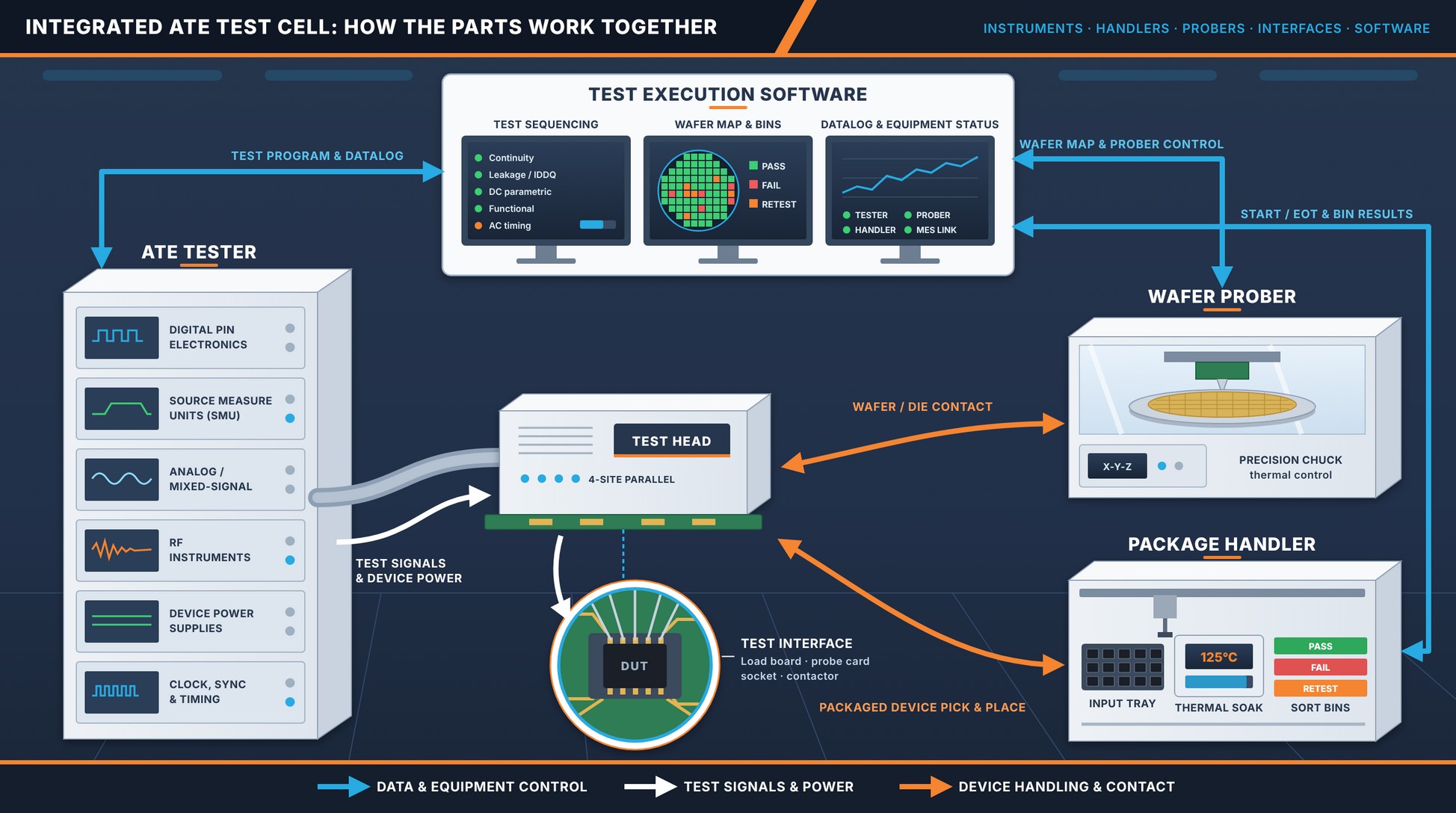
An automated test cell combines several systems to stimulate a device under test (DUT), measure its response, and record the results. Its configuration varies according to whether the process involves wafer-level testing or packaged devices.
The main components include:
ATE instruments: Generate electrical signals, apply power, measure device responses, and check performance against defined specifications.
Handlers: Move packaged devices into and out of the test position, manage temperature conditions, and sort devices according to test results.
Probers: Position wafers and individual dies for electrical contact during wafer-level testing.
Test interfaces: Load boards, probe cards, sockets, and contactors establish the electrical connection between the tester and the DUT.
Test software: Controls test sequences, communicates with equipment, captures measurements, and manages pass/fail decisions.
These components must operate as a coordinated system rather than as independent pieces of equipment.
How Do Engineers Integrate Instruments, Handlers, and Probers?
1. Match ATE Instruments to Device Requirements
Instrument selection begins with the electrical characteristics that need to be evaluated. Digital devices may require pattern generation and timing measurements, while analog, RF, and mixed signal products need suitable measurement resources for their specific signals. Engineers should review voltage and current ranges, frequency requirements, channel count, measurement accuracy, and supported test capabilities. They must also check whether the selected tester can accommodate the required load boards and device interfaces.
A suitable ATE testing setup should support the complete test plan without introducing unnecessary equipment complexity. Compatibility with existing infrastructure and future device requirements also deserves attention during selection.
2. Coordinate Handlers and Probers with the Tester
Handlers and probers manage how devices reach the test interface. A handler is generally used for packaged components, while a prober positions wafers or dies for electrical contact. Mechanical compatibility is essential. Engineers need to verify docking arrangements, interface dimensions, contact alignment, device orientation, and temperature-control requirements. Poor alignment or inconsistent contact can cause intermittent results and unnecessary retesting. For wafer testing, probe cards must match the device layout and contact requirements. For packaged components, sockets and contactors must suit the package type and expected test conditions. The tester, handling equipment, and interface hardware should be validated together before production use.
3. Integrate Test Software and Equipment Controls
Test software connects the different parts of the cell through defined sequences and communication interfaces. It controls instrument operations, triggers measurements, receives handler or prober status, and records device results. Engineers should verify that the software can coordinate equipment actions, manage test parameters, and handle interruptions or equipment errors. It should also maintain consistent communication with the tester and relevant production systems.
A modular software structure can make updates and debugging easier. Clear equipment status messages, error handling, and traceable test records help teams identify whether a failure comes from the device, test program, or hardware setup.
What Should Engineers Consider During Test Cell Development?
Throughput, Parallelism, and Temperature
A test cell must meet the required production rate without compromising measurement quality. Multisite testing can increase throughput by testing multiple devices simultaneously, but it also introduces additional requirements for channel allocation, contact consistency, and test resource management.
Available real estate on the test hardware, such as space on the load board, probe card, or socket area, is also a constraint when evaluating multisite testing, since it limits how many sites can be accommodated along with the required supporting components.
Temperature control is another important consideration. Device behavior can change across operating temperatures, making stable thermal conditions necessary for characterization and qualification. Handlers, probers, and thermal systems must therefore support the test conditions defined for the device.
Calibration, Correlation, and Repeatability
Before a test cell enters regular operation, instruments and interfaces need to be checked for correct operation. Calibration, contact verification, and test program correlation help establish
confidence in the measurements.
Teams should compare results across equipment, sites, and test conditions to identify variations.
A structured test engineering process also includes monitoring measurement trends, investigating unexpected failures, and maintaining test program versions.
These activities strengthen semiconductor testing by helping teams distinguish genuine device failures from issues caused by the test setup.
How Can an Integrated Test Cell Be Validated?
Validation should cover the complete workflow, from device loading to result sorting and data reporting. Engineers can begin with equipment-level checks, followed by interface verification, software integration, and test program execution.
The next step is to run representative devices through the intended test sequence. Teams should review measurement consistency, contact reliability, temperature stability, equipment communication, and result handling. Any mismatch between expected and recorded behavior should be investigated before the cell is released.
Documentation also matters. Keeping updated equipment configurations, interface details, calibration records, and test program versions makes the setup easier to maintain and reproduce. A well-integrated cell supports dependable testing while giving engineering teams a clearer view of device performance and production quality.
Developing Integrated Test Solutions at Tessolve
At Tessolve, we bring together test strategy, ATE test solutioning expertise, hardware and software development to support semiconductor device test and production.
ATE platform expertise: Our experience covers more than 30 ATE platforms, including Advantest, Teradyne, National Instruments, etc.
Test solution development: We support test solution development for NPI, platform conversion, and efficiency scaling.
Product engineering: Our work includes PVT characterization, correlation, JEDEC and Automotive qualification, yield optimization, and production sustenance.
Testing infrastructure: Our facilities include multiple ATE test floors, FA and Reliability Lab, Qualification Labs, and characterization facilities.
These capabilities help us address test cell requirements across digital, analog, power management, mixed-signal, RF, and sensor devices.
Conclusion
A dependable ATE test cell depends on how well its parts work together. Instruments must match device requirements, handlers and probers must align mechanically with the tester, and test software must coordinate equipment actions and record results consistently. Careful attention to throughput, temperature control, calibration, and correlation, followed by structured validation and clear documentation, helps teams release a test cell that delivers accurate and repeatable results.
Frequently Asked Questions
1. What is an ATE test cell?
An ATE test cell combines automated instruments, handling equipment, device interfaces, and software to evaluate semiconductor performance and classify test results.
2. What is the difference between a handler and a prober?
Handlers position packaged devices for testing, while probers align semiconductor wafers or dies with electrical probe contacts.
3. Why is test software important in ATE integration?
Test software communicates with equipment, executes measurement sequences, captures results, manages errors, and supports consistent reporting across test operations.
4. What affects ATE test cell throughput?
Throughput depends on test time, parallelism, device handling speed, contact reliability, temperature stabilization, and efficient equipment coordination.
5. How is an ATE test cell validated?
Engineers verify equipment operation, interface connections, calibration, software sequences, measurement consistency, and device sorting before production release.
6. What are the benefits of multisite testing?
Multisite testing evaluates testing of several devices at the same time, which increases throughput and makes better use of tester resources. It can lower test cost per device, provided channel allocation, HW real estate, test time and contact consistency are well managed.