
The automotive industry is rapidly evolving with the emergence of Software-Defined Vehicles (SDVs), where software capabilities now play a central role in defining vehicle performance, safety, and user experience. Unlike traditional vehicles that relied primarily on mechanical engineering, modern vehicles depend heavily on complex software systems.
This transformation has increased the importance of continuous validation and testing. Hardware-in-the-Loop (HiL) testing has become a critical method for validating embedded systems by simulating real-world conditions in a controlled environment. However, as software complexity grows, scaling HiL to support continuous testing pipelines presents a major challenge.
At the same time, advancements in semiconductor testing are ensuring that the hardware foundation of these vehicles remains reliable. To keep up with rapid innovation cycles, automotive companies must adopt scalable and automated testing frameworks that align with modern development practices.
What Are Software-Defined Vehicles (SDVs)?
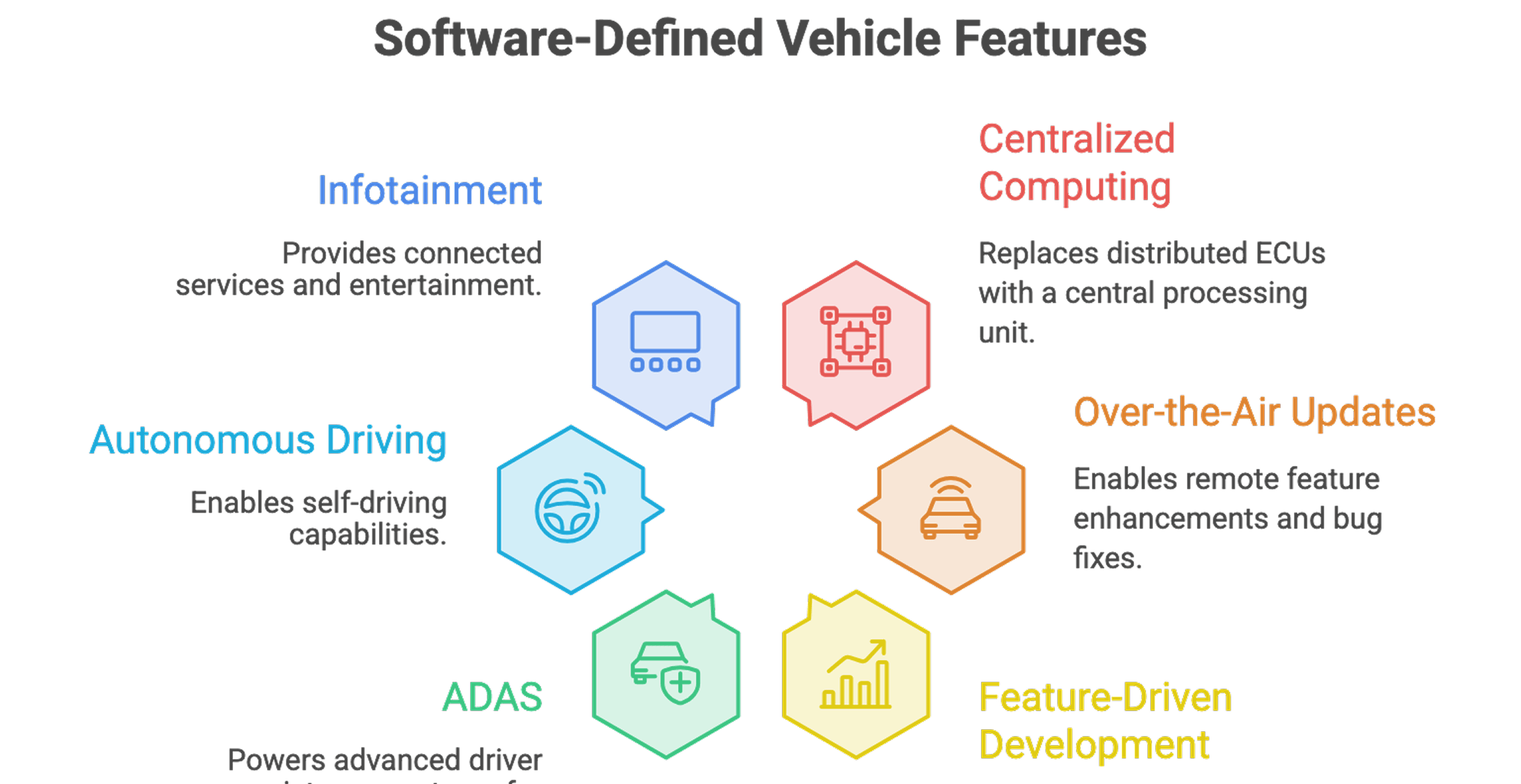
Software-Defined Vehicles (SDVs) are vehicles where software controls most functionalities, enabling continuous updates and improvements throughout the vehicle’s lifecycle.
Key Characteristics
- Centralized computing architectures replacing distributed ECUs
- Over-the-Air (OTA) updates for remote feature enhancements
- Feature-driven development lifecycle enabling continuous upgrades
Role of Software in SDVs
Software powers critical systems such as:
- Advanced Driver Assistance Systems (ADAS)
- Autonomous driving technologies
- Infotainment and connected services
As vehicles become more software-centric, the need for robust test engineering practices becomes essential to ensure safety and performance. Additionally, reliable chip test processes help validate the underlying hardware, ensuring consistent functionality across different operating conditions.
Why Continuous Testing Is Essential
Frequent software updates demand continuous validation to prevent regressions, maintain safety standards, and ensure seamless user experiences.
High-Reliability Testing for Mission-Critical Aerospace & Automotive Electronics
Understanding Hardware-in-the-Loop (HiL) Testing
Hardware-in-the-Loop (HiL) testing is a technique used to test embedded systems by connecting real hardware components, such as ECUs, to a simulated environment.
How HiL Works
- Real ECUs interact with virtual vehicle models
- Simulated environments replicate real-world conditions
- Test scenarios are executed automatically
Core Components of HiL Systems
- Real-time simulators for dynamic system modeling
- I/O interfaces for hardware connectivity
- Test automation tools for executing test cases
Benefits of HiL Testing
- Safe validation of edge cases and failure scenarios
- Reduced reliance on physical prototypes
- Faster and more cost-effective testing cycles
Limitations of Traditional HiL
Traditional HiL setups are often rigid and resource-intensive. While engineering testing services can support implementation, many systems struggle to scale efficiently. Moreover, aligning HiL environments with evolving semiconductor testing requirements adds another layer of complexity.
The Need for HiL at Scale in SDVs
Modern vehicles now integrate multiple ECUs and domain controllers, each requiring extensive validation across numerous real-world scenarios. At the same time, the automotive industry is shifting toward Agile and DevOps practices, leading to faster release cycles and continuous software updates. This combination of increasing system complexity and rapid development demands makes continuous testing and quick feedback loops essential for ensuring reliability and performance.
Key Challenges in Traditional Setups
- Limited HiL lab capacity
- Slow and manual testing workflows
- Difficulty in parallel test execution
Why Scaling HiL Is Critical
Scaling HiL enables:
- Parallel execution of test cases
- Faster validation cycles
- Improved utilization of testing resources
By adopting advanced test engineering strategies, organizations can automate workflows and enhance efficiency. At the same time, robust chip test processes ensure hardware reliability under continuous testing conditions.
Challenges in Scaling HiL Testing
Scaling HiL testing is complex and involves multiple technical and operational hurdles:
- Limited Hardware Availability HiL rigs are expensive and not easily scalable, restricting parallel testing capabilities
- High Infrastructure Costs Expanding HiL labs requires significant investment in hardware and maintenance
- Lack of Standardization Different tools, platforms, and configurations create integration challenges
- CI/CD Integration Issues Traditional HiL systems are not always compatible with modern continuous integration pipelines
- Data Management and Traceability Handling large volumes of test data while maintaining traceability is difficult
- Real-Time Performance Constraints Maintaining low latency and high accuracy becomes challenging at scale
- Resource Utilization Inefficiencies Poor scheduling and manual processes lead to underutilized systems
Leveraging specialized engineering testing services can help address these issues by optimizing infrastructure and workflows. Additionally, advancements in semiconductor testing ensure that hardware platforms are capable of supporting large-scale, real-time validation demands.
Building Continuous Testing Pipelines for HiL
Integrating HiL with CI/CD Pipelines
Continuous Integration and Continuous Deployment (CI/CD) have become essential in modern automotive software development. They enable faster iteration, early defect detection, and seamless deployment of updates. Integrating HiL into CI/CD pipelines ensures that every code change is validated in near real-time.
Trigger-based testing plays a crucial role here. Tests can be automatically initiated at different stages, such as code commits, build completions, or release candidates. This approach minimizes manual intervention and accelerates feedback cycles.
Various tools and frameworks support this integration, allowing teams to connect simulation environments with automated workflows. As systems grow more complex, aligning these pipelines with semiconductor testing processes ensures that both software and hardware layers are validated cohesively.
Virtualization and Cloud-Based HiL
Virtualization has transformed traditional HiL systems by introducing Virtual HiL (vHiL), where software models replicate hardware behavior. This reduces dependency on physical test benches and enables early-stage validation.
Cloud-based HiL further enhances scalability by allowing teams to run multiple simulations in parallel without hardware limitations. It offers flexibility, on-demand resources, and cost optimization.
A hybrid approach combining virtual and physical HiL provides the best of both worlds. While virtual environments accelerate testing, physical systems ensure real-world accuracy. This balance is particularly valuable when working with complex validation workflows supported by advanced engineering testing services.
Test Automation and Orchestration
Automation is the backbone of scalable HiL testing. Automated test execution eliminates repetitive manual tasks and ensures consistency across test cycles.
Scheduling and parallel execution enable multiple test cases to run simultaneously, significantly reducing validation time. This is especially important for large-scale automotive systems with numerous dependencies.
Orchestration tools help manage resources efficiently by allocating workloads, monitoring system usage, and optimizing test execution. Incorporating robust test engineering strategies ensures that automation frameworks remain scalable, maintainable, and adaptable to evolving requirements.
Digital Twins and Simulation Models
Digital twins are virtual replicas of physical systems that allow continuous monitoring and testing in a simulated environment. They play a key role in scaling HiL by enabling extensive testing without relying solely on hardware.
Model-based testing uses mathematical and logical models to validate system behavior early in the development cycle. This approach improves accuracy and reduces development risks.
Scenario-based simulations further enhance testing by replicating real-world driving conditions, including edge cases. These simulations rely heavily on precise chip test validation to ensure that the underlying hardware behaves as expected under different conditions.
Key Technologies Enabling Scalable HiL
Several advanced technologies are powering the scalability and efficiency of modern HiL systems. Here’s a breakdown:
Edge Computing
Brings data processing closer to the source, reducing latency in real-time simulations. This is crucial for time-sensitive automotive applications like ADAS and autonomous driving, where immediate feedback is required.
High-Performance Simulation Platforms
Provide the computational power needed to accurately model complex vehicle systems, including powertrain, sensors, and control units. These platforms support large-scale parallel testing, enabling faster validation cycles.
Artificial Intelligence and Machine Learning (AI/ML)
Help optimize test scenarios by identifying high-risk areas, predicting failures, and improving overall test coverage. AI-driven insights also reduce redundant test cases and enhance efficiency.
Containerization Technologies (e.g., Docker-like Environments)
Ensure consistent deployment of testing frameworks across different systems and teams. Containers make it easier to replicate environments, scale testing infrastructure, and maintain compatibility across platforms.
Data Analytics and Test Intelligence
Enable teams to process and analyze massive volumes of test data. This helps in identifying trends, improving traceability, and making data-driven decisions for continuous improvement.
Cloud Computing and Distributed Infrastructure
Allow on-demand scaling of HiL resources, supporting multiple simulations simultaneously without heavy investment in physical hardware. This also enables global collaboration across development teams.
Together, these technologies create a flexible, scalable, and highly efficient ecosystem that supports continuous testing pipelines for Software-Defined Vehicles.
Best Practices for Implementing HiL at Scale
Adopting a shift-left testing approach is critical for identifying issues early in the development lifecycle. This reduces costs and minimizes late-stage defects.
Building modular and reusable test frameworks allows teams to scale efficiently while maintaining consistency. These frameworks can be easily adapted to different projects and requirements.
Continuous monitoring and feedback loops ensure that testing processes remain aligned with development goals. Real-time insights help teams make faster and more informed decisions.
Standardization across tools, platforms, and processes is essential for seamless integration and scalability. It reduces complexity and improves collaboration across teams.
Finally, strong collaboration between software and hardware teams ensures that both domains evolve together, enabling more effective and reliable validation strategies.
Industry Use Cases and Real-World Applications
Automotive OEMs are increasingly adopting scalable HiL pipelines to support the development of advanced vehicle systems. These pipelines enable continuous validation across multiple domains.
In autonomous driving, HiL testing is used to validate perception, decision-making, and control systems under various simulated scenarios. This ensures safety and reliability before real-world deployment.
Electric vehicle (EV) battery management systems also rely on HiL for performance and safety validation. Similarly, infotainment systems are tested extensively to ensure seamless connectivity and user experience.
The benefits of scalable HiL adoption are significant:
- Faster time-to-market
- Improved software quality
- Reduced development risks
- Enhanced system reliability
Future of HiL in Software-Defined Vehicles
The future of HiL testing is moving toward fully virtualized environments, where most validation can be performed without physical hardware. This shift will significantly improve scalability and reduce costs.
Cloud-native HiL solutions are expected to become more prevalent, enabling global teams to collaborate and test in real time. AI-driven testing pipelines will further enhance automation by intelligently selecting test cases and predicting potential failures.
As autonomous vehicle technologies continue to evolve, continuous validation will become even more critical. Scalable HiL systems will play a central role in ensuring safety, reliability, and performance in next-generation Software-Defined Vehicles.
Tessolve: Enabling Scalable HiL and Advanced Testing Solutions
At Tessolve, we understand that the future of automotive innovation depends on robust, scalable, and intelligent testing ecosystems. As Software-Defined Vehicles continue to evolve, the need for integrated validation across both hardware and software layers becomes more critical than ever.
Our expertise spans end-to-end validation, from automotive electronics to advanced semiconductor testing, ensuring that every component performs reliably under real-world conditions. With deep capabilities in system validation and automation, Tessolve delivers tailored solutions that accelerate development cycles while maintaining the highest quality standards.
We also specialize in comprehensive engineering testing services, enabling organizations to build scalable HiL environments that seamlessly integrate with modern CI/CD pipelines. By combining domain expertise with cutting-edge tools and methodologies, Tessolve helps automotive companies transition toward continuous testing frameworks with confidence.
Whether it’s optimizing validation workflows or enhancing system reliability, Tessolve empowers businesses to stay ahead in the rapidly evolving world of Software-Defined Vehicles.
Frequently Asked Questions
1. What is Hardware-in-the-Loop (HiL) testing in automotive?
HiL testing connects real vehicle hardware with simulated environments to validate system behavior, enabling safe, controlled, and repeatable testing of complex automotive functions.
2. Why is HiL important for Software-Defined Vehicles?
HiL ensures continuous validation of software updates in SDVs, helping maintain safety, reliability, and performance as vehicle features evolve through frequent releases.
3. How does CI/CD integration improve HiL testing?
CI/CD integration automates test execution during development stages, enabling faster feedback, early defect detection, and seamless validation of software changes in pipelines.
4. What is Virtual HiL (vHiL)?
Virtual HiL replaces physical hardware with software models, allowing scalable, cost-effective testing while enabling early validation before actual hardware becomes available.
5. What are the main challenges in scaling HiL systems?
Scaling HiL involves hardware limitations, high costs, integration issues, data management complexities, and maintaining real-time performance across large, distributed testing environments.
6. How do digital twins support HiL testing?
Digital twins replicate real systems virtually, enabling continuous simulation, predictive analysis, and large-scale testing without relying entirely on physical hardware setups.
7. What benefits do scalable HiL pipelines offer automotive companies?
Scalable HiL pipelines accelerate development cycles, improve software quality, enable parallel testing, reduce costs, and ensure reliable validation of increasingly complex vehicle systems.